
Set pieces in tactical organisation have moved far beyond their traditional role as isolated moments within the game. What was once treated as a secondary phase has become a structured and deliberate component of how teams organise, compete and gain advantage. Modern football has exposed the limits of improvisation, pushing coaching staffs to approach set pieces as repeatable tactical frameworks rather than occasional opportunities.
As tactical organisation has grown more complex, set pieces in modern tactical organisation now reflect collective behaviour, predefined roles and clear spatial principles. Their influence is no longer limited to scoring or defending goals, but extends to controlling momentum, managing game states and reinforcing a team’s overall structure. This shift explains why elite teams devote increasing analytical and training resources to these situations.
Understanding set pieces in tactical organisation is therefore essential to grasp how contemporary teams think, prepare and execute tactical plans within highly structured competitive environments.
Set pieces in tactical organisation as part of team structure
Set pieces in tactical organisation are integrated into the overall team structure rather than treated as isolated situations. Their preparation reflects how a team organises space, assigns roles and coordinates collective movement under controlled conditions. Within modern tactical organisation, set pieces provide a clear framework in which positioning, timing and responsibility are predefined and repeatedly trained. This allows teams to reproduce tactical behaviour with precision and consistency.
As football has evolved, set pieces in tactical organisation have become moments where tactical order is most visible. Players operate within clearly established structures that mirror the principles applied during open play, reinforcing coherence across all phases of the game. Defensive and offensive set pieces both reveal how teams prioritise organisation over improvisation, using structure to reduce uncertainty and manage risk. In this context, set pieces function as an extension of team organisation, offering a concentrated expression of tactical planning and collective discipline within modern football.
Set pieces in tactical organisation have evolved from isolated actions into structured tactical frameworks that reflect collective behaviour, predefined roles and spatial principles, shaping how teams organise, control game states and execute tactical plans in modern football
Set pieces in tactical organisation as structured tactical phases
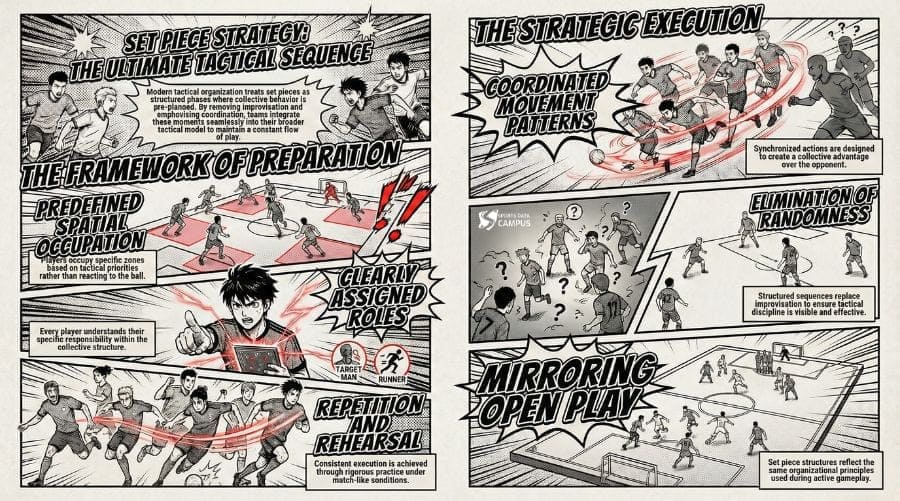
Set pieces in modern tactical organisation operate as structured tactical phases where collective behaviour is planned and executed within a controlled framework. Unlike open play, these situations allow teams to establish predefined structures that reduce randomness and emphasise coordination. This structured nature explains why set pieces are increasingly analysed as complete tactical sequences rather than isolated restarts.
Within modern tactical organisation, these phases share common characteristics that align them with the team’s broader tactical model:
- Predefined spatial occupation, where players occupy specific zones according to tactical priorities.
- Clearly assigned roles, ensuring each player understands their responsibility within the structure.
- Coordinated movement patterns, designed to synchronise actions and create collective advantage.
- Repetition and rehearsal, allowing behaviours to be executed consistently under match conditions.
Set pieces in tactical organisation therefore act as moments where tactical discipline becomes highly visible. The absence of improvisation highlights the importance of preparation and reinforces collective understanding. Offensive and defensive structures during set pieces often mirror the same organisational principles applied in open play, maintaining tactical coherence across different phases of the game.
By treating set pieces as structured tactical phases, teams integrate them seamlessly into their overall organisation. These situations no longer interrupt the tactical flow of the match but instead concentrate it, offering a controlled environment in which team structure, coordination and collective intent are expressed with maximum clarity.
Set pieces in modern tactical organisation and collective behaviour
Set pieces in tactical organisation provide a clear window into collective behaviour, as every action depends on coordinated execution rather than individual initiative. These situations expose how players interact within a shared structure, revealing levels of tactical understanding, discipline and synchronisation. Because roles and movements are predefined, success relies on collective timing and mutual awareness.
Within modern tactical organisation, set pieces demand that players act as part of a single unit. Individual decisions are subordinated to the structure, reinforcing collective responsibility. This is especially evident in how teams manage spacing, adjust positioning and respond to cues triggered by the ball’s delivery or the opponent’s movement.
Key aspects of collective behaviour during set pieces in modern tactical organisation include:
- Synchronous movement, where actions are coordinated to occur at precise moments.
- Shared spatial references, allowing players to orient themselves in relation to teammates rather than opponents alone.
- Collective anticipation, based on rehearsed patterns rather than reactive decisions.
- Role interdependence, where the effectiveness of each action depends on the execution of others.
These behaviours reflect broader tactical principles applied during open play, but set pieces intensify them by removing uncertainty. The structured context highlights how teams prioritise cohesion over improvisation and collective execution over individual expression.
Set pieces in tactical organisation therefore function as condensed demonstrations of team behaviour. They show how tactical ideas are translated into coordinated action and how collective discipline underpins organisation. Through these phases, teams reinforce shared habits and tactical coherence, strengthening their overall organisational identity within modern football.
Set pieces in tactical organisation and tactical culture
Set pieces in modern tactical organisation are closely linked to tactical culture, as they reflect how teams interpret organisation, discipline and repetition within the game. Tactical culture shapes the way set pieces are designed, rehearsed and executed, turning them into consistent expressions of a team’s identity rather than isolated solutions. Through repeated training and structured planning, these situations become embedded habits that reinforce collective understanding.
Within modern tactical organisation, set pieces highlight the importance of shared principles. Teams that prioritise organisation tend to approach these moments with a clear cultural framework, where structure and coordination prevail over spontaneity. This cultural dimension explains why set pieces often reveal deeper tactical tendencies than open play, as they expose how teams think when conditions are controlled.
Key elements linking set pieces in tactical organisation to tactical culture include:
- Repetition of structured behaviours, reinforcing collective habits.
- Consistency in role interpretation, aligned with the team’s tactical identity.
- Emphasis on organisation and discipline, reducing reliance on improvisation.
- Transmission of tactical principles, especially in teams with strong organisational traditions.
Set pieces in tactical organisation therefore act as carriers of tactical culture. They translate abstract principles into visible behaviour, strengthening coherence across the team. By analysing these phases, it becomes possible to understand how tactical ideas are internalised and expressed collectively within modern football.
Set pieces in tactical organisation within modern football
Set pieces in modern tactical organisation must be understood within the broader context of modern football, a game increasingly shaped by structure, preparation and tactical precision. As collective organisation has become central to performance, these situations have gained strategic relevance as controlled moments where tactical principles are applied with clarity. Modern football reduces margins for improvisation, and set pieces reflect this shift by rewarding teams that prioritise organisation over spontaneity.
Within modern tactical organisation, set pieces function as stable reference points in an otherwise dynamic game. They allow teams to impose order, manage game states and express tactical identity under predefined conditions. This explains why set pieces are no longer treated as isolated events, but as integral components of how teams structure both offensive and defensive behaviour. Their role aligns with the broader evolution of football towards systematic preparation and repeatable tactical execution.
Understanding set pieces in tactical organisation therefore requires a specialised perspective that goes beyond general tactical knowledge. As football continues to evolve, the ability to design, analyse and integrate set pieces into team organisation has become a distinct area of expertise. This need for specialisation is addressed by the MSc Degree in Set Pieces in Football, a programme focused on the tactical, analytical and organisational dimensions of set pieces within modern football. For professionals aiming to operate at an advanced tactical level, specialised education in set pieces offers a direct pathway to mastering one of the most decisive phases of the contemporary game.
Turn set pieces into points. Specialise in modern tactical organisation with the MSc Degree in Set Pieces in Football.