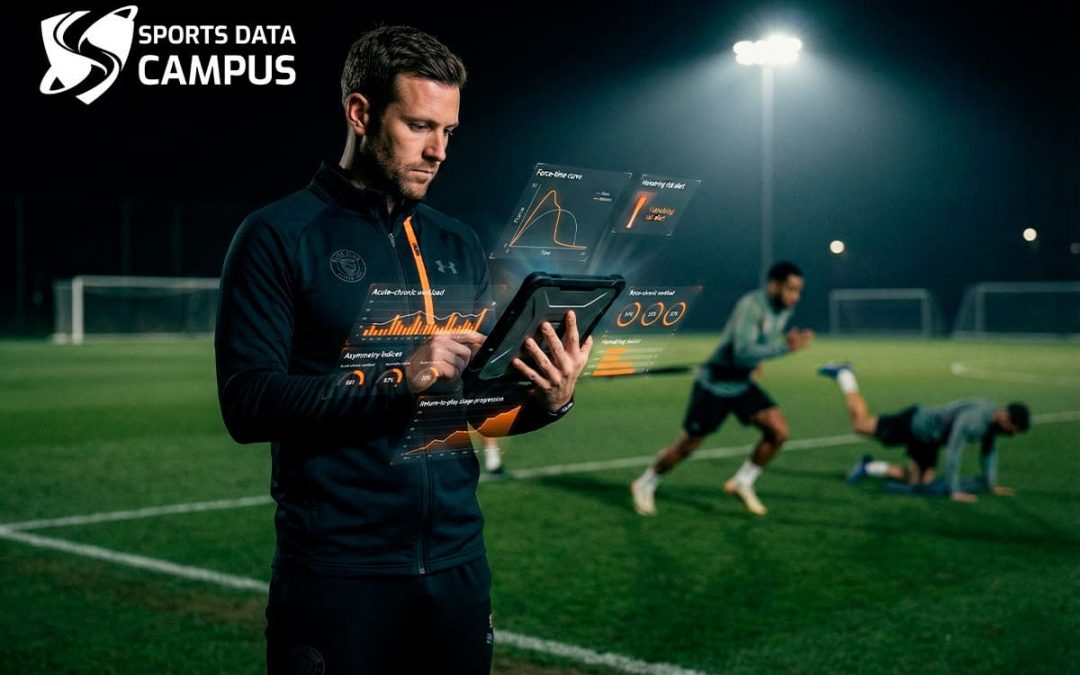
Injury prevention and rehabilitation in elite athletes has changed dramatically in recent years. What once relied on instinct, standard timelines and gut feeling now depends on advanced technology, regular assessments and objective criteria.
Within this new framework, data analysis in injury prevention and rehabilitation makes it possible to detect imbalances, anticipate relapses and tailor recovery processes with precision and scientific rigour.
The role of data analysis in injury prevention and rehabilitation in athlete health
In professional sport, every decision regarding an athlete’s health has a direct impact on performance. Availability, consistency and physical condition are no longer left to chance. They are managed through evidence.
In this context, data analysis in injury prevention and rehabilitation becomes an essential tool. It enables practitioners to anticipate risk, detect deviations from baseline values and personalise recovery processes with precision. Rather than reacting to injury, teams work proactively, using objective metrics to protect performance and extend athletic longevity.
- Prevention is not simply about avoiding injuries, but about identifying risk factors, monitoring neuromuscular load and making clinical decisions grounded in evidence.
- Rehabilitation, in turn, is not just a return to training, but a structured process of reintroducing the athlete into competition with full functional, physical and psychological readiness.
For years, time was the main criterion used to assess recovery. However, data has shown that this approach is insufficient. Objective metrics provide a real picture of the athlete’s condition and allow for more rigorous intervention.
With tools such as force platforms, dynamometers and isometric testing, the body begins to speak through data. It is no longer about assumptions, but about quantifiable evidence that guides treatment and decision-making.
Data analysis in injury prevention and rehabilitation transforms intuition into clinical knowledge. It enables the design of individualised processes, reduces the risk of relapse and moves performance preparation towards a smarter, evidence-led model.
Thanks to data analysis, rehabilitation is no longer a straight line driven by fixed dates, but a dynamic process guided by metrics, focused on real outcomes and tailored to each athlete
Periodic assessments and evidence-based criteria
Effective prevention starts from a clear premise: what is not measured cannot be improved. In data analysis in injury prevention, carrying out periodic assessments is the first step in identifying risks, adapting treatment plans and making clinical decisions based on real information rather than intuition.
A benchmark example is the model applied at Aspetar Orthopaedic and Sports Medicine Hospital, where patients recovering from anterior cruciate ligament surgery were clinically assessed every six weeks. These evaluations included objective measurements of mobility, strength, motor control and patient-reported perception. The aim was not merely to record data, but to detect deficiencies early and adjust the process before they developed into significant setbacks.
Numerous studies have confirmed that time alone is not a reliable indicator for authorising a return to play. In a systematic review of more than 200 scientific publications on discharge criteria following ACL injury, over 60% of protocols were still based solely on the number of months elapsed, without considering strength testing, jump performance, functional output or the athlete’s subjective perception. That approach is outdated and exposes athletes to avoidable relapses.
By contrast, applying objective criteria such as limb symmetry ratios, peak isometric force values, gait analysis and validated perception questionnaires provides a precise snapshot of the athlete’s condition. These tools allow for genuine individualisation, help identify the 20% of patients with irregular recovery patterns and support safer, more effective return-to-play decisions.
From clinic to performance: How has the rehabilitation process evolved?
One of the major advances in data analysis in injury prevention and rehabilitation has been its ability to bridge the gap between clinical care and performance. The objective is no longer limited to eliminating pain or restoring joint range of motion. It is about returning the athlete to peak competitive level with full physical and biomechanical guarantees.
Each pathology, and each athlete, follows a distinct progression. In complex injuries such as anterior cruciate ligament reconstruction, data clearly highlights differences depending on the type of graft used, whether hamstring tendon, bone–patellar tendon–bone or allograft. These variations directly influence strength development, neuromuscular asymmetry and the athlete’s response to specific loading patterns. No two knees are identical, and no two recoveries follow a standard script.
Throughout the rehabilitation phase, systematic evaluation makes it possible to monitor key functional parameters such as strength levels measured through dynamometry, load symmetry, active mobility, motor control, balance quality and progressive tolerance to effort. These metrics do not only guide the practitioner. They also provide feedback to the athlete, who can visualise progress through curves, figures and performance graphs that reinforce engagement with the process.
Force platform data, for instance, often reveals discrepancies between eccentric and concentric phases during squats or jumps. This can expose hidden deficits in the affected limb, even when pain has already resolved. That level of precision is essential when deciding whether to progress, maintain or restructure the intervention plan.
Through data analysis, rehabilitation is no longer a linear timeline driven by calendar dates. It becomes a dynamic, metric-led process focused on real outcomes and tailored to the individual athlete.
The importance of neuromuscular metrics
The neuromuscular system drives every athletic action. Understanding how it activates, how it responds and how it adapts following injury is fundamental in any prevention or rehabilitation process. This is where data analysis in injury prevention provides real added value, enabling practitioners to assess neuromuscular efficiency objectively and with precision.
Tools such as dynamometry, isometric testing and isokinetic evaluation allow professionals to measure maximal strength, muscle group ratios and inter-limb symmetry levels. These assessments identify not only obvious deficits, but also hidden imbalances that may determine the success or failure of recovery.
For example, an isometric knee extension test may reveal 65% symmetry in an athlete who has already been clinically discharged. Although pain has resolved, the data shows that functional capacity remains well below the level required for safe competition. This type of insight makes it possible to intervene before a relapse occurs.
Force curve analysis is another key resource. It is not enough to consider peak force alone. The quality of the curve, including its slope, stability and time to peak, provides valuable information about motor unit activation, nervous system control and muscle contraction efficiency. An irregular graph may indicate neuromuscular inefficiency, even if the final figure appears acceptable.
Integrating these metrics into daily practice allows professionals to adjust training loads with rigour, tailor strength and motor control programmes and make informed decisions. In short, applying neuromuscular data does more than enhance recovery. It transforms it into a scientific, progressive and measurable process.
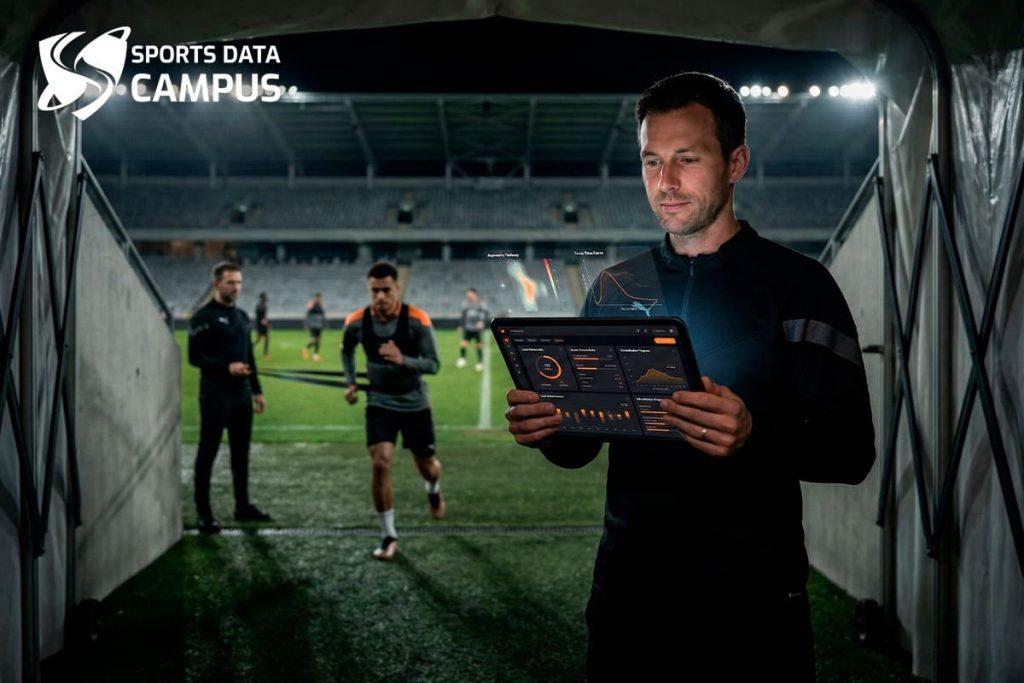
Key metrics in jumping and explosive strength
Jumping is not merely an expression of power. Within the context of prevention and rehabilitation, it becomes a functional diagnostic tool that reveals the true state of the neuromuscular system. Through tests such as the Countermovement Jump (CMJ) or the Drop Jump, data analysis in injury prevention enables practitioners to assess the ability to generate and absorb force, detect hidden asymmetries and monitor progress during advanced stages of rehabilitation.
The CMJ, for instance, is a simple, safe and highly sensitive test. It involves performing a vertical jump following a rapid knee flexion, without the use of the arms. The vertical force curve, recorded through force platforms, allows three key phases to be identified: eccentric (descent), concentric (propulsion) and flight phase. Each phase provides precise information about intermuscular coordination, contraction velocity and the ability to convert force into effective movement.
- In the early stages, deficiencies are often observed during the eccentric phase, with prolonged durations or irregular force peaks.
- As the athlete progresses, propulsion efficiency improves and inter-limb asymmetry gradually decreases.
- Landing phase analysis is equally crucial, as fear, hesitation or incomplete recovery often manifest in uneven load distribution, even when jump height appears similar.
In many cases, these tests identify functional deficits that are not detectable through a conventional clinical examination. For this reason, they are used both as an assessment tool and as a source of feedback throughout the rehabilitation process.
Jump data is never interpreted in isolation. It is integrated with other strength and motor control metrics to build a comprehensive functional profile that supports informed decision-making. In this way, jumping evolves from a simple test into an objective window into neuromuscular performance.
Measuring reactive strength and braking capacity
Sporting performance depends not only on how much force an athlete can produce, but also on how effectively it can be absorbed and rapidly redirected. This ability, known as reactive strength, is critical in movements such as changes of direction, decelerations and repeated jumps. In the context of prevention and rehabilitation, measuring this capacity helps identify functional deficits that increase the risk of relapse, particularly in lower-limb injuries.
One of the most relevant metrics in this area is the Reactive Strength Index (RSI), which relates jump height to ground contact time. The higher the RSI, the more efficient the stretch–shortening cycle. A modified RSI, obtained from vertical jumps such as the CMJ or Drop Jump, allows this relationship to be analysed specifically for each limb.
In clinical practice, low RSI values or marked inter-limb asymmetries often indicate incomplete recovery. During tests such as a 30 cm Drop Jump, many athletes show significant compensation towards the unaffected leg, especially in the landing phase. Even when jump height appears acceptable, prolonged contact time or uneven load distribution reveals limitations in braking capacity and safe force transfer.
With the use of force platforms and specialised analysis software, it is now possible to observe the full force-time curve, from loading phase through to deceleration and propulsion. This approach allows practitioners not only to measure, but also to train reactive strength in a targeted way, adjusting exercise progression according to the objective response of the neuromuscular system.
By integrating these metrics into ongoing monitoring, load control improves, training stimuli are refined and timing errors in return-to-competition decisions are reduced. Prevention is not simply about assessment. It is about acting on what the data reveals.
Return-to-running analysis
Returning to running is both a psychological and physical milestone in any rehabilitation process. However, far from being a simple chronological step, it must be a clinical decision grounded in data and aligned with the athlete’s functional reality. Data analysis in injury prevention makes it possible to objectify this stage and establish safe, individualised criteria.
One of the most common mistakes is still linking the return to running to a fixed timeframe, such as three months post-surgery. The literature shows that only a minority of athletes are truly ready at that point. For this reason, centres such as Aspetar Orthopaedic and Sports Medicine Hospital apply multifactorial criteria, including minimum quadriceps strength of at least 70%, full joint range of motion, absence of swelling, validated perception questionnaires and prior progression on Alter-G treadmills or in aquatic environments.
Running itself is not a uniform task. Jogging is not comparable to sprinting, changing direction or reaching maximal acceleration. Within data-driven analysis, factors such as load asymmetry, joint moments, intersegmental coordination and speed tolerance are evaluated to determine when and how each component should be introduced.
Progression is rarely linear. In many cases, limitations do not emerge at the outset, but during intermediate or advanced phases, when neuromuscular demand and joint impact increase. Continuous monitoring through force platforms, CMJ testing, sprint analysis and GPS data is therefore essential.
These records help identify persistent structural deficits, compensatory running patterns or early overload warnings. Instead of applying generic protocols, data analysis enables practitioners to design progression strategies tailored to the athlete’s specific profile, ensuring a safer, stronger and more efficient return to performance.
The professional who masters both technological tools and the human context of the athlete is better equipped to deliver effective, sustainable solutions tailored to high performance
Beyond the data
Data analysis in injury prevention and rehabilitation has transformed the way injuries are managed in sport. However, data alone is not enough. It must be interpreted, contextualised and combined with clinical expertise, knowledge of the athlete and the real conditions of the competitive environment. Data is a tool, not a substitute for professional judgement.
Quantitative information requires perspective. A low strength value does not carry the same meaning in an 18-year-old player as it does in a veteran with a history of three previous injuries. Nor can the progression of an athlete with an irregular menstrual cycle be compared directly with that of another with a different hormonal profile. Age, sex, sport-specific demands, playing position, competitive level and medical history all decisively influence how each metric should be interpreted.
Daily interaction with the athlete also remains an essential source of insight. Ongoing communication, observation of body language, emotional response to training and self-perceived physical condition provide qualitative data that complements and enriches technical analysis. In many cases, it is precisely the combination of both dimensions that allows practitioners to anticipate issues or adjust decisions in time.
It is impossible to prevent every injury. Yet it is entirely possible to identify risk profiles, design targeted interventions and reduce uncertainty. That is the real function of data analysis. Not to eliminate risk, but to manage it proactively and in a personalised manner.
In this context, the professional who masters both technological tools and the human dimension of the athlete is best positioned to deliver effective, sustainable solutions tailored to high-performance sport.
Artificial Intelligence and machine learning in injury prevention
The integration of Artificial Intelligence and machine learning techniques into data analysis in injury prevention and rehabilitation marks a new era in sports health management. These technologies make it possible to process vast volumes of information, detect complex patterns and anticipate risks that lie beyond traditional human analysis.
High-performance clubs and centres now generate thousands of data points per session, including isometric strength metrics, jump symmetry values, sprint speeds, GPS load, questionnaire responses, biochemical markers, thermal data and recovery indicators. The challenge is not simply collecting this information, but interpreting it collectively in order to predict individual behaviours.
This is where the potential of Artificial Intelligence becomes clear. Through algorithms trained on historical datasets, it is possible to identify combinations of variables that precede injury, such as a drop in eccentric jump velocity, altered load distribution on force platforms, persistent neuromuscular fatigue patterns or sudden changes in acceleration metrics. The value does not lie in a single metric, but in the correlation of multiple variables analysed simultaneously.
By integrating data from GPS systems, dynamometry, functional testing or surface electromyography, predictive models become more robust and personalised. These models do not replace clinical judgement, but act as early warning systems that support load planning, resource prioritisation and preventive strategies.
There are still limitations, including a lack of standardised measurement protocols, the need for large, high-quality datasets and the risk of misinterpreting algorithms without expert oversight. Nevertheless, this is the direction in which the field is moving. And it will be professionals trained in data science who lead the practical application of these systems in real high-performance environments.
Train to lead prevention and rehabilitation through data
The professional profile that masters data analysis in injury prevention is increasingly in demand across clubs, national teams and high-performance centres. Knowing how to interpret metrics, apply technology and make evidence-based clinical decisions is no longer optional. It is the standard.
If you want to take this qualitative step forward in your career, enrol in the Sports Data Campus Master’s Degree in Sports Science and Data Intelligence in High-Performance. You will learn through real case studies, cutting-edge technology and lecturers with elite-level experience, equipping yourself to become the reference professional your team truly needs.
Request information through the following form.