
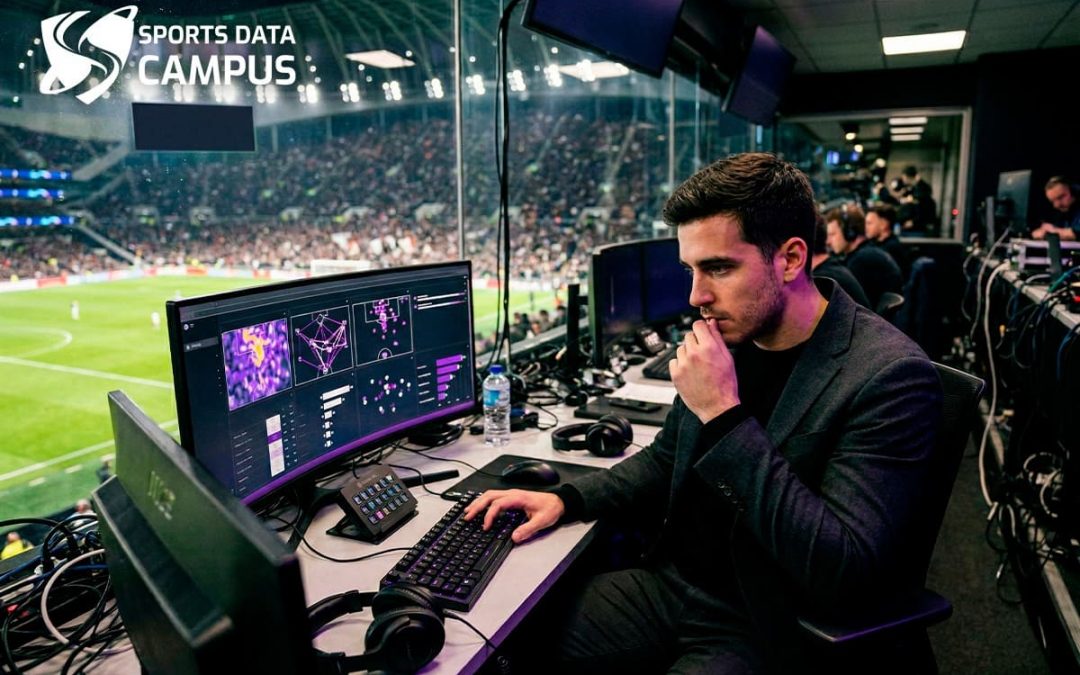
To analyse a match live requires interpreting tactical data, individual decisions and collective dynamics in real time to turn observation into competitive advantage. Live analysis combines context, advanced metrics and a strategic reading of the game as it evolves second by second.
When you decide to analyse a match live, you work under constant information pressure. The game shifts at every moment and forces you to detect structural adjustments, changes in pressing, variations in tempo and how teams use space.
Professional analysis goes beyond the scoreline, as the analyst identifies recurring patterns, measures collective behaviours and evaluates the impact of tactical decisions in real time. Technology enhances this process through live data, advanced metrics and visualisation tools that reduce uncertainty.
In elite football, live analysis makes the difference between reacting too late or anticipating with precision. Mastering the right steps turns observation into strategic decision-making for coaches, analysts and professional clubs.
How to analyse a match live correctly?
To interpret the game in real time with accuracy, observation must be structured around collective behaviour rather than the ball. The tactical shape, defensive line height and relationships between lines reveal the team’s true model.
Next, ball circulation and use of space are assessed. It involves identifying whether the team progresses through central areas or wide channels, whether it attacks with width or overloads the spaces between lines. Transitions and counter-pressing define the moments of greatest imbalance.
Professional analysis combines contextual understanding with objective data to turn observation into strategic decision-making in professional football.
Live tactical analysis requires a structured methodology, contextual understanding and advanced technological support to interpret collective patterns and generate immediate competitive advantage
Analysis process step by step
Pre-match preparation
If you want to analyse a match live with precision, everything starts before the first whistle. Preparation shapes the quality of the analysis that follows, because without prior study, live reading loses depth and competitive context.
Before the match, you should:
- Review the likely line-ups and usual tactical systems.
- Analyse how each team builds from the back and what defensive line height they use.
- Assess how they manage attacking and defensive transitions.
This groundwork allows you to anticipate patterns and spot real variations during the match.
You then support that tactical framework with recent metrics such as:
- Possession volume.
- Ball recoveries by zone.
- Duel efficiency.
- Attacking output.
These variables provide a quantitative base that you can compare with what happens live. The use of Big Data reduces subjectivity and improves interpretative accuracy.
It also helps to define specific points of focus in advance, whether that is build-up play, high pressing or the holding midfielder’s behaviour in the defensive phase, because narrowing your attention avoids scattered analysis and improves the quality of your notes. To do this, prepare notation tools or tracking platforms that structure the collection of information. A professional analyst does not improvise. They arrive with clear hypotheses and a defined observation framework.
Live observation and data collection
When the match starts, you need to turn your preparation into dynamic reading. To analyse a match live requires sustained focus and the ability to prioritise, because not everything that happens carries the same strategic value.
- First, you observe the actual structure without the ball. The distance between lines, the height of the block and body orientation reveal the defensive plan and allow you to identify whether the team is executing as expected or making adjustments on the fly.
- During the attacking phase, you analyse progression. You track passing sequences, activation zones and the number of supporting options inside or out wide, understanding that transitions define competitive level through how quickly a team reorganises after losing possession.
- At the same time, you collect quantifiable data alongside your tactical reading. Opponent-half recoveries, duel efficiency, vertical passes and entries into the final third provide objective context, and combining qualitative observation with live metrics strengthens the analysis.
- Technology enhances the process through tracking platforms, real-time dashboards and predictive models that detect patterns not visible to the naked eye. Even so, professional judgement remains decisive, because data guides the process, but interpretation is what creates real competitive value.

Post-match evaluation
Live analysis does not end with the final whistle. After the match, a decisive phase begins where you must contrast your initial hypotheses with the full set of recorded data, assessing whether the interpretations made in real time still hold once the context is no longer shaped by immediacy.
At this stage, you review in a structured way:
- The hypotheses established before the match and their level of fulfilment
- The patterns detected live and their actual frequency throughout the game
- Complete tactical sequences that may have only been partially perceived in real time
- Key decisions that shifted the competitive balance
This consolidated analysis allows you to distinguish between momentary perceptions and structural trends, reinforcing the methodological consistency of the process.
In addition, linking tactical variables with physical metrics provides a comprehensive view of performance. Evaluating intensity, distribution of repeated efforts or behaviour after losing possession helps to adjust workloads and optimise weekly planning. At this point, the use of Big Data and advanced analysis tools transforms information into cumulative knowledge.
Ultimately, post-match evaluation turns each game into a source of strategic learning. It is not just about explaining what happened, but identifying what should be maintained, what needs correction and how to prepare the next match with greater competitive precision.
What turns live analysis into a competitive advantage?
Live tactical analysis only becomes a competitive advantage when interpretation goes beyond simple description and explains why specific behaviours occur within the strategic context of the match. Recording actions is not enough. Real value emerges when you identify dynamic relationships between structure, tempo and decision-making.
The advantage appears when you distinguish between structural patterns and situational events, avoiding premature conclusions based on isolated sequences. The scoreline, the initial game model and emotional management influence every collective behaviour, so professional analysis requires integrating these variables into a coherent framework that supports the diagnosis throughout the match.
In addition, combining tactical reading with objective evidence strengthens interpretative reliability. Metrics do not replace judgement, but they allow you to validate perceptions and confirm emerging patterns. When qualitative and quantitative information converge, analysis moves beyond narrative and becomes a strategic tool.
This ability to synthesise is what separates technical observation from applied competitive insight, and it is precisely this methodological shift that explains why professional clubs invest in analytical structures capable of turning the game into actionable knowledge.
Live analysis transforms tactical data and advanced metrics into immediate strategic decisions that optimise competitive performance and reduce the margin of error in professional environments
Applications of live analysis in professional clubs
In professional football, to analyse a match live has a direct impact on strategic decision-making, as real-time analysis shapes tactical adjustments, structural changes and substitutions that can alter the competitive direction of the match. It is not an academic exercise, but an operational necessity where every reading has immediate consequences.
- Coaching staff use live analysis from the bench to detect imbalances in collective structure, identifying whether the opponent breaks lines, creates overloads out wide or exploits key spaces.
- Performance departments integrate match data into longitudinal models to evaluate physical load, repeated high-intensity efforts and pressing patterns, linking Big Data with physical preparation and injury prevention.
- Scouting departments rely on live analysis to assess players under real competitive pressure, providing more reliable insights into decision-making, tactical adaptability and contextual awareness.
- Clubs that incorporate Artificial Intelligence and predictive models go beyond interpretation and anticipate recurring trends, turning analysis into a structural advantage for sustained performance.
If you want to turn this methodology into a professional skill applied to high performance, the next step is to train in the Master’s Degree in Scouting Applied to Football, where you will learn to assess players in competitive contexts, interpret advanced metrics and apply analytical technology in real club environments.
Fill in the form below to receive more information about the Master’s Degree in Scouting Applied to Football
How much does live analysis influence a coach’s decisions?
Live analysis plays a decisive role in tactical adjustments, system changes and strategic substitutions. Real-time reading allows coaches to detect structural imbalances, opponent superiority or drops in intensity, enabling decisions based on evidence rather than emotional perception.
Is it necessary to master Big Data to analyse matches professionally?
In modern professional football, mastering Big Data is essential. To analyse a match live requires interpreting advanced metrics, performance models and longitudinal patterns that complement traditional tactical reading. Without the ability to integrate structured data, analysis loses precision and methodological consistency.
What is the difference between watching a match and analysing it professionally?
Watching involves describing what happens, while professional analysis means interpreting causes, identifying structural patterns and linking them to strategic decisions. Live analysis integrates competitive context, objective metrics and tactical judgement to turn information into real competitive advantage.