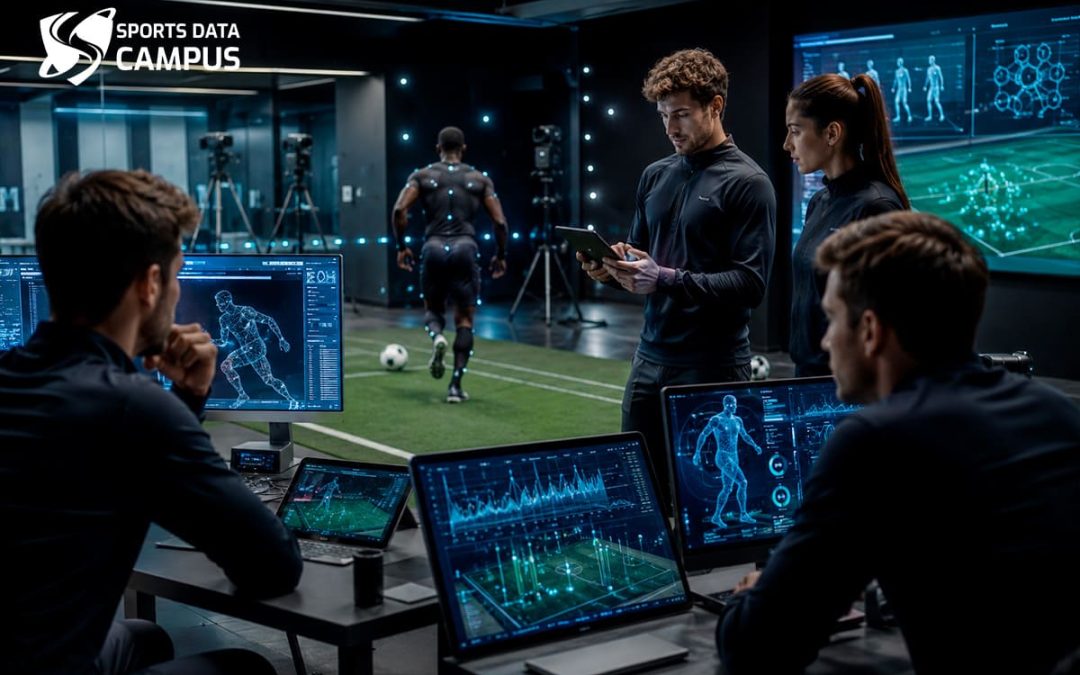
Biomechanics examines how the body moves in sport, turning every movement into valuable data to improve athletic performance. It analyses forces, ground contact, acceleration, coordination, asymmetries and neuromuscular control.
In modern training, biomechanics helps us understand how athletes run, jump, decelerate, strike and change direction. It also combines sensors, motion analysis, biomechanical data and Artificial Intelligence to support more informed decisions about technique, training load, injury prevention and rehabilitation.
Biomechanics has become an essential tool for optimising sports performance.
Advanced Biomechanics Applied to Performance in Modern Sport
Advanced biomechanics applied to sports performance helps identify what limits an athlete’s performance and which aspects of their movement need improving. It is not about collecting as many metrics as possible, but about selecting data that explain speed, power, technical efficiency and physical injury risk.
This analysis focuses on three key areas that connect movement, force and body control during sporting activity:
- Kinematics examines body positions, velocities, accelerations and coordination between body segments.
- Kinetics analyses forces, impulses, joint moments and load distribution.
- Neuromuscular control helps assess stability, stiffness, movement variability, fatigue and compensatory movement patterns.
When these three areas are analysed together, specialists can move beyond observing individual movements and begin to understand how the body functions as an interconnected system. Biomechanics therefore transforms movement into valuable information to refine technique, guide training, reduce injury risks and make more informed decisions about sports performance.
Biomechanics uses data to analyse movement in sport, helping to improve technique, performance, injury prevention and decision-making
Biomechanical Variables That Influence Sports Performance
Biomechanical variables help explain how athletes generate speed, power, stability and efficiency during specific movements. The key is not to collect as many metrics as possible, but to select those directly linked to the sporting movement and the decisions the coaching team needs to make.
The main biomechanical variables are best understood by linking force, timing and coordination to specific decisions:
- Ground contact time measures how long an athlete remains in contact with the ground when applying force during sprinting, jumping or changing direction.
- Impulse helps explain the amount of force applied over a specific period and its effect on acceleration.
- Power measures the ability to generate force at high speed during explosive movements.
- Functional stiffness helps assess how the muscle-tendon system stores and releases energy.
- Asymmetries identify persistent differences between limbs that may affect performance or increase mechanical loading.
- Intersegmental coordination examines how the hips, knees, ankles, trunk and arms work together during movement.
These variables help distinguish between technical issues, physical limitations and inefficient movement strategies. Two athletes may reach the same speed using different movement patterns, but one may experience greater joint loading, less effective force transfer or higher energy losses.
This is why biomechanics turns the analysis of sporting movements into a practical tool for improving performance. Data can be used to develop working hypotheses, refine technique, guide specific strength training, monitor fatigue and improve sports performance using objective criteria.
Technology and Sensors for Movement Analysis
Technology brings biomechanics out of the laboratory and onto the training ground, but this progress is not about equipping athletes with as many devices as possible. The real value comes when each tool answers a specific question about performance. Specialists need to understand how much force an athlete applies, how they distribute their weight during ground contact, what accelerations they generate, how each body segment rotates and how their movement patterns change as fatigue sets in.
The main technologies and sensors provide valuable insights when each serves a specific purpose within biomechanical analysis:
| Technology | What it measures | How it helps |
|---|---|---|
| Force plates | Impulse, power, rate of force development and asymmetries | Assess force production, explosiveness and differences between limbs |
| IMUs | Accelerations, rotations, impacts and changes of direction | Analyse movement patterns on the pitch and changes caused by fatigue |
| 2D and 3D video analysis | Joint positions, body segment trajectories and technical coordination | Interpret sporting movements and provide context for technical execution |
| Markerless motion capture systems | Body movement without physical markers | Make biomechanical assessments quicker and easier in real-world training environments |
| Portable EMG | Muscle activation and neuromuscular timing | Understand how muscles coordinate during movement |
| Instrumented insoles | Pressure, contact times and plantar pressure distribution | Analyse mechanical loading, foot mechanics and ground contact efficiency |
However, no technology can improve performance on its own. Data must be collected using reliable protocols, consistent measurements and interpreted in the context of training. Force plates provide insights into the mechanical forces involved, video analysis offers a technical perspective, and inertial sensors make it possible to track daily changes. When these data sources are properly integrated, biomechanics becomes an ongoing tool for refining technique, monitoring training load and optimising sports performance.
Biomechanics, Injury Prevention and Rehabilitation
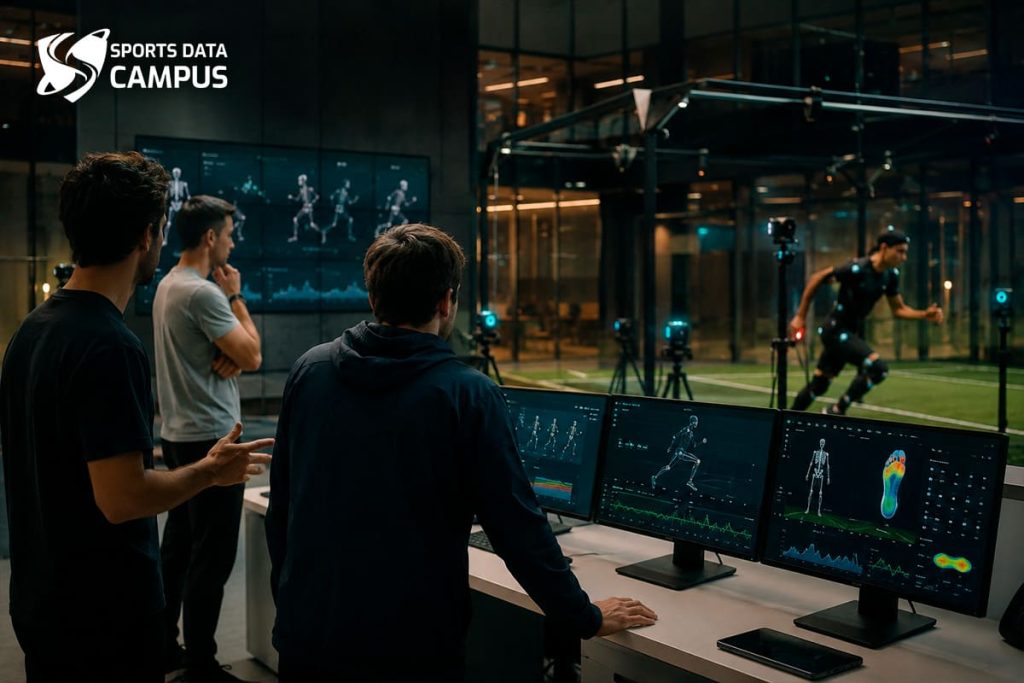
Biomechanics provides an objective assessment of the mechanical risks associated with movement in sport. The aim is not to achieve perfect technique or ideal posture, but to identify movement patterns that increase the load on tissues, joints and muscle groups when athletes accelerate, decelerate, jump, land or change direction.
In injury prevention and rehabilitation, biomechanical analysis helps identify issues that coaches and specialists may not always detect through observation alone, such as:
- Persistent asymmetries between limbs that affect force distribution and alter movement mechanics.
- Loss of control under fatigue when athletes can still perform a task but begin to change the way they move.
- Inefficient landing strategies involving excessive stiffness, poor shock absorption or concentrated loading on the knees, ankles or hips.
- Mechanically demanding changes of direction caused by poor foot placement, trunk positioning or reduced pelvic stability.
- Reduced eccentric strength capacity that limits deceleration, energy absorption and tolerance to explosive movements.
- Movement compensations that develop following pain, previous injuries or increased competitive demands.
These indicators should not be treated as isolated diagnoses because their real value comes from interpreting them alongside an athlete’s injury history, training load, fatigue levels and competitive context. A movement pattern that appears acceptable when an athlete is fresh may become less safe if it deteriorates after repeated efforts or under pressure.
Therefore, biomechanics helps guide rehabilitation and return-to-sport programmes more precisely. It allows athletes to progress from controlled exercises to real sporting movements, assess whether movement quality is maintained and determine when they are ready not only to return to sport, but also to perform consistently and effectively.
Integrating Biomechanics with Sports Analytics and Artificial Intelligence
Biomechanics delivers its greatest value when integrated with sports analytics and Artificial Intelligence. This approach combines biomechanical data with external training load, fatigue, competitive context, athlete history and training objectives.
This integration transforms movement analysis into a system capable of identifying patterns, explaining changes in performance and guiding more precise interventions:
- Biomechanical data collection using sensors, video analysis, force plates or inertial measurement systems during real sporting activities.
- Data cleaning and synchronisation to organise signals, remove noise and link each measurement to a specific phase of movement.
- Pattern analysis to identify asymmetries, reduced efficiency, technical changes or responses to fatigue.
- Integration with training load and context to connect movement patterns with playing time, intensity, surface conditions, opposition and competition schedules.
- Dashboard visualisation to help coaching and performance teams interpret trends without getting lost in disconnected metrics.
- Artificial Intelligence models to identify athlete profiles, predict potential risks and support training or rehabilitation decisions.
The aim is not to replace coaches, strength and conditioning specialists or rehabilitation professionals, but to give them a deeper understanding of movement. Artificial Intelligence helps identify relationships that are not always immediately apparent, while biomechanics provides the technical context needed to interpret each variable.
The future of sports performance therefore depends on professionals who can combine movement analysis, data, technology and Artificial Intelligence. This approach aligns naturally with the Master’s in Artificial Intelligence Applied to Sports at Sports Data Campus, designed for professionals who want to apply AI, advanced analytics and technology to improve sports performance.