
Sports decision-making has entered a new era. Intuition and accumulated experience are no longer enough. Today, data analysis in sports decision-making drives tactical, physical and organisational progress. Elite teams, coaching staff and performance departments rely increasingly on quantitative insight to understand what truly happens both on and off the pitch.
From patterns of play to training loads and market trends, everything is examined with precision to gain a competitive edge. This shift is not theoretical. It shapes every pass, every rotation and every key call. Understanding how this ecosystem works is essential for anyone who wants to be part of the present and future of professional sport.
How is data analysis used in sport?
Data analysis in sport acts as a cross-cutting framework linking performance, strategy, health, talent identification and fan experience. Its application now spans the entire sporting ecosystem, from daily training sessions to real-time strategic decision-making.
It is not simply about collecting information. The real value lies in turning raw data into actionable insight. To achieve this, professional organisations combine multiple data sources, including biometric, tactical, psychological and contextual inputs, with advanced processing and visualisation tools. This approach makes it possible to detect patterns, anticipate scenarios and support key decisions with an unprecedented level of accuracy.
To fully understand how data analysis operates in sport, it is essential to explore the tools and techniques behind it, the most commonly used data types and the way this information ultimately translates into concrete decisions within the sporting environment.
Elite teams, coaching staff and performance departments increasingly rely on quantitative data to gain a clearer understanding of what happens both on and off the pitch
Tools and analytical techniques
Data analysis in sport is not just about gathering numbers. It is about knowing how to use them to improve decisions. For that reason, clubs and analysts rely on tools that allow them to record, process and visualise information quickly and effectively.
Among the most common are programmes such as Excel, R and Python. In professional environments, however, specialised platforms are also widely used, including Tableau, Power BI, SkillCorner, Hudl and StatsBomb. These tools make it possible to combine physical, technical and tactical data in order to identify what works and what needs adjustment.
When it comes to analysis itself, different techniques are applied depending on the objective:
- If the aim is to understand what is happening in a training session or match, descriptive analysis is used.
- If the goal is to determine how one variable influences another, for example how weekly load affects the number of sprints, statistical comparisons are applied.
- And if the objective is to anticipate risks or outcomes, predictive models are built to estimate what is likely to happen.
Systems are also used to uncover hidden patterns within datasets, map relationships between players or match situations, and integrate information from multiple sources to build a more complete picture of performance. The key is not simply having data, but knowing how to interpret it in order to make better decisions.
In sport, analytical techniques exist to turn numbers into decisions. Everything begins with a clearly defined objective, such as:
- Describe performance: Simple and direct data are analysed, such as the number of sprints, successful passes or training load. This type of analysis provides a clear snapshot of what is happening.
- Link variables: If the aim is to understand how one factor affects another, for example whether fatigue reduces shooting accuracy, datasets are compared to draw evidence-based conclusions.
- Predict outcomes: Models are developed using historical data to anticipate scenarios such as injury risk, a player’s expected performance or even the likely result of a match.
Added to this are other advanced techniques such as:
- Identifying patterns within large volumes of information through data mining.
- Understanding relationships between players or collective behaviours using network analysis.
- Integrating different types of data, including physical, tactical and psychological inputs, to gain a holistic view of the team.
The better this combination of tools is mastered, the more precise and effective the decisions become.
Types of data used in sport
Data analysis in sport draws on multiple sources, each serving a specific role in understanding performance and supporting decision-making. These datasets are generally grouped into five main categories:
- Biometric data include physiological variables such as heart rate, perspiration rate, oxygen saturation, neuromuscular load and sleep quality. They are used to monitor an athlete’s physical condition and anticipate fatigue or injury risk. This type of information is particularly valuable when designing individualised training plans and recovery programmes.
- Performance data quantify execution in competition, including speed, number of sprints, success in duels, completed passes and shots taken. These metrics provide an objective view of both individual and collective performance and are essential for benchmarking and tracking progression over time.
- In team sports, tactical data become especially relevant. Analysts examine patterns of play, attacking and defensive structures, transitions and spatial occupation. The use of video analysis and tracking data allows these dynamics to be represented in a visual and measurable way.
- Contextual data, such as weather conditions, altitude, venue and recovery time, also influence performance and must be considered during planning.
- Finally, fan behaviour data help optimise commercial strategies and enhance the spectator experience through personalised marketing and data-driven decision-making.
Data analysis in sports decision-making
Today, data analysis provides an objective foundation for building more effective strategies, reducing errors and anticipating scenarios with greater precision. Whether selecting a line-up, adjusting training load or preparing a game plan, data help turn uncertainty into something measurable and manageable.
This process begins with the continuous collection of relevant information, including physical performance, technical execution, psychological variables and contextual factors. However, the real value lies in accurate interpretation. Visualisations, dashboards and statistical models transform raw data into meaningful insight by revealing hidden patterns, warning signals, areas for improvement and more efficient decision pathways.
Impact on game strategy
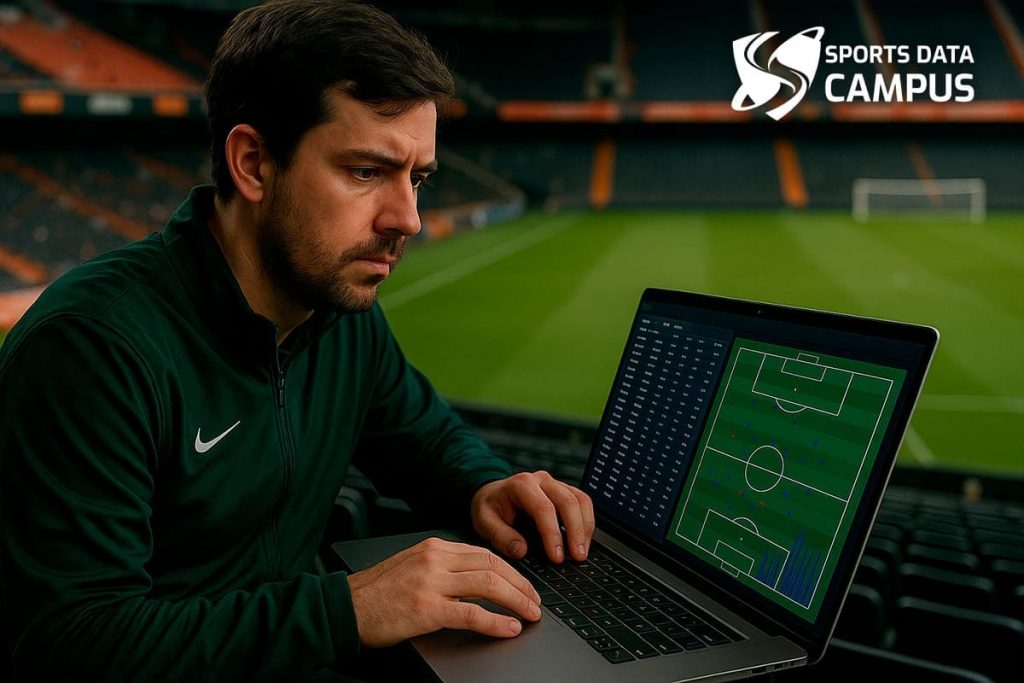
Data analysis is reshaping the way game strategy is designed, adapted and executed. In the past, tactical plans relied almost entirely on direct observation and the coaching staff’s experience. Today, every decision can be supported by numerical and visual evidence that helps detect opponents’ patterns, identify vulnerable areas and optimise the team’s collective behaviour.
Thanks to tracking systems and computer vision tools, it is now possible to examine spatial occupation, counter-pressing intensity, defensive compactness and ball progression across different areas of the pitch in remarkable detail. This level of insight allows transitions to be refined, tactical structures to be adjusted and specific match scenarios to be prepared in advance.
In addition, real-time analysis enables immediate decisions during the game itself. A formation change, a substitution or a positional correction is no longer an instinctive reaction, but a response grounded in data revealing performance drops or tactical imbalances. In this way, analysis does not simply shape pre-match planning, it also supports dynamic in-game management.
Integrating data into tactical decision-making turns every minute of a match into an opportunity to optimise performance and gain an intelligent edge over the opposition.
Data analysis in athletic performance
Data analysis now makes it possible to understand athletic performance in a comprehensive way, covering physical, technical, tactical and psychological dimensions. It is no longer enough to observe whether an athlete runs more or scores more goals. What truly matters is understanding how performance is achieved, in what context and with what level of efficiency. This holistic perspective enables training to be tailored, imbalances to be prevented and both individual and collective strengths to be enhanced.
In practical terms, this involves monitoring internal and external load, analysing the biomechanics of technical actions, assessing decision-making in real match situations and evaluating the athlete’s psychological state. When interpreted correctly, data become a structured guide for optimising each of these performance factors.
From tactical planning and injury prevention to scouting, nutrition, performance management and fan experience, every aspect can be measured, understood and optimised
Optimising athlete performance
Optimising performance is not about training more, but about training smarter. Data analysis makes it possible to build personalised programmes that respond to each athlete’s specific needs, taking into account physical condition, performance history, objectives and competitive context. This level of personalisation is essential for reaching peak performance without drifting into overtraining or increased injury risk.
From a physical perspective, data allow workloads to be adjusted, efficient microcycles to be designed and the body’s adaptation to training stimuli to be assessed. Devices such as GPS trackers, accelerometers and force platforms provide precise information on effort, recovery and movement patterns. At a technical level, video analysis supports improvements in movement mechanics, helps eliminate inefficiencies and enhances overall execution.
Psychological variables are also examined, including focus, competitive stress and self-confidence. Integrating questionnaire data, qualitative observation and hormonal biomarkers opens the door to a more structured and effective mental preparation process.
Finally, the training environment itself is monitored. Sleep quality, dietary adherence and even the impact of social surroundings can all influence athletic capacity. Data analysis turns these elements into measurable variables, offering a competitive advantage built on complete personalisation of the high-performance pathway.
Data analysis is no longer a tool reserved for a handful of elite clubs. It has become the new standard in modern sport. Today, any decision not grounded in data creates a competitive disadvantage. From tactical planning and injury prevention to scouting, nutrition, performance management and fan engagement, everything can be measured, understood and optimised.
However, turning data into real decisions requires education, critical thinking and a clear methodology. That is why the MSC Data Analytics in Football has been designed as a direct gateway to the future of sport. Developed alongside professional clubs, the programme covers everything from core principles to the advanced use of tools, metrics, software and real analytical models.
Enrolling on this master’s degree is not simply about learning how to handle data. It is about developing the ability to transform data into competitive advantage. It means understanding the game from a different perspective and building a solid professional career in a rapidly expanding sector. In modern sport, knowledge makes the difference.
Want to be one of them? Fill in the form below to receive more information about the MSC Data Analytics in Football