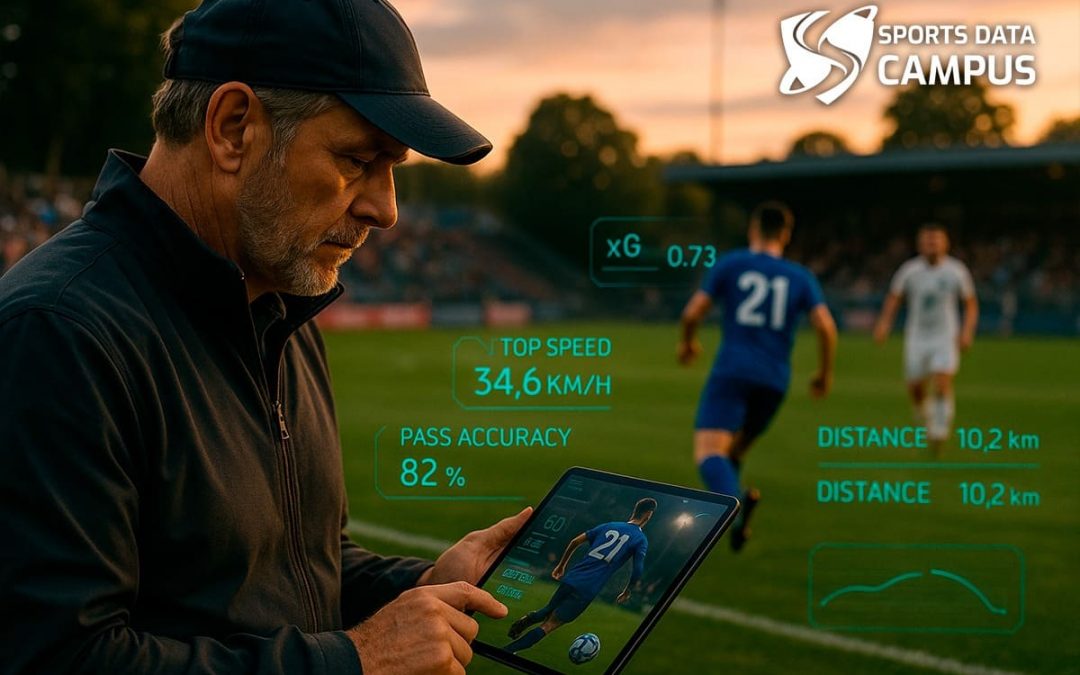
Scouting with data has drastically transformed professional football. Gone are the days when scouts relied solely on watching matches and gut feeling. Today, advanced tools make it possible to take more informed decisions and reduce uncertainty. But using data doesn’t guarantee success — it can also lead to mistakes.
The transformation of scouting with data in football
The rise of data scouting has allowed clubs to fine-tune their recruitment strategies and squad planning with much more precision. Teams no longer depend solely on live scouting — they can now analyse patterns of play, assess long-term performance and spot talent in less explored markets. What’s more, global databases make it easier to compare players from different leagues and identify the right profiles to fit into a team’s tactical setup.
From notepads to predictive models
Data-driven scouting moves from qualitative observation to quantitative performance modelling. For years, analysis relied on written reports produced after specific matches, with subjective assessments of decision-making, intensity or tactical awareness. Today, those same behaviours are translated into measurable variables such as defensive action volume, creation of positional advantages, contribution during pressing phases or efficiency in duels.
The integration of structured databases makes it possible to analyse thousands of events per player and identify recurring patterns across different competitive contexts. Based on that information, clubs apply statistical models and Machine Learning algorithms to estimate consistency, long-term development and the probability of adapting to a new tactical environment.
The combined use of Big Data and Artificial Intelligence introduces a more objective framework for prioritising player profiles. Visualisation tools such as Power BI make internal interpretation easier, while predictive models help project future performance through standardised historical data.
The shift from the notebook to predictive modelling does not mean abandoning observation. It means integrating quantifiable evidence into sporting decision-making
Data scouting has helped clubs sharpen their recruitment strategies and squad planning
Advantages of scouting with data
Data-driven scouting provides operational and strategic advantages that directly impact squad planning and transfer market efficiency. In today’s professional game, the goal is no longer simply to collect statistics, but to structure decisions around quantifiable and contextualised evidence.
- Greater accuracy in player evaluation: Analysis no longer focuses on isolated actions because clubs now work with metrics normalised per 90 minutes, possession-adjusted data and performance linked to competitive context. Indicators such as defensive duels in a team’s own half, progression under pressure or contribution during transition phases help interpret real behaviours within the tactical model. This structured approach reduces reliance on isolated impressions and improves consistency across technical reports.
- Reduced margin for error in transfers: Combining expert observation with longitudinal data reduces cognitive bias. Evaluating consistency across different seasons, performances against varying levels of opposition and adaptation to multiple tactical systems helps identify players whose output may be inflated by context or short-term form. Predictive models also help estimate development potential, competitive stability and the level of risk attached to an investment.
- More accurate cross-league comparisons: Global databases allow clubs to compare players performing similar roles across different competitions. Adjustments for tempo, defensive intensity or possession volume create more realistic equivalencies between leagues. This broadens the recruitment market and improves the identification of talent in less visible environments.
- Optimisation of time and resources: Scouting departments can filter hundreds of profiles using statistical criteria before activating live scouting processes. Preliminary analysis reduces unnecessary travel and allows qualitative assessment to focus only on candidates already validated through data.
Hits and misses in data scouting
The success story of Vedat Muriqi and Mallorca
The signing of Vedat Muriqi by RCD Mallorca in 2022 is a clear example of how data-backed scouting can play a key role in decision-making.
The problem
During his time at S.S. Lazio, Muriqi struggled. Between 2020 and 2022, he played 49 official matches and scored only 2 goals — a disappointing return that raised doubts about his ability to perform at top level.
The data analysis
Despite a modest spell in Italy, Mallorca’s analysts dug deeper into his career and found compelling stats. Back at Fenerbahçe S.K. in Turkey, he had been a prolific striker — 17 goals in 36 matches during the 2019–20 season. On top of that, his record for Kosovo’s national team was impressive, with 18 goals in 37 appearances by the time he signed for Mallorca.
These numbers showed that when Muriqi felt valued and played a key role, his performances improved significantly. His physical style and aerial ability also matched Mallorca’s tactical needs.
The decision
Based on this analysis, RCD Mallorca brought Muriqi in on loan in January 2022. He made an instant impact — 5 goals and 3 assists in 16 league matches, playing a crucial role in keeping the team in LaLiga. As a result, the club activated the buy option in July 2022, signing him for five seasons and making him the most expensive signing in the club’s history, at €9.3 million.
Results
Since his arrival, Muriqi has become a key player in Mallorca’s attacking setup. In the 2022–23 season, he led the team with 15 league goals, finishing as top scorer. His partnership with players like Dani Rodríguez was particularly effective — together they were involved in 65% of the team’s goals since his debut.
This case shows how deep data analysis can uncover talents whose potential may not be obvious from surface stats — helping clubs make smart, strategic signings.

A common mistake – ignoring the tactical system
One of the most frequent errors in data-driven scouting is overlooking how a player fits into the tactical setup of their new team. Focusing only on individual stats without context can lead to failed transfers.
Real-life case – Lázaro Vinicius at Almería (2024)
In 2024, Almería spent €7 million to sign Lázaro Vinicius, a 20-year-old Brazilian forward with huge potential. But his time in Andalucía was underwhelming. Despite standout moments — including three goals against Mallorca and one at the Bernabéu versus Real Madrid — Lázaro struggled to adapt to Almería’s playing style. He lacked rhythm and connection with teammates, making it clear that he didn’t fit into the coach’s tactical approach. The club even considered loaning him to Palmeiras, but the Brazilian side chose not to activate the purchase option, and he returned to Almería.
The issue
Lázaro had shone previously in a system that highlighted his best qualities. But Almería’s tactical scheme was different and required him to adjust his game. The lack of analysis on how his strengths would fit the new system led to below-par performances.
Conclusion
This highlights how data scouting must not stop at assessing individual performance. It also needs to consider how a player’s skills blend into the team’s overall playing style. Contextual analysis is key to avoiding failed signings and ensuring new arrivals truly strengthen the squad.
The right mix of data and observation is what will define success or failure in the scouting of the future
Artificial Intelligence and sensor technology applied to Scouting
Modern analysis integrates automation, physical tracking and statistical modelling to increase the depth of the evaluation process. This evolution makes it possible to incorporate biomechanical variables and risk projections into the professional scouting environment.
Automated Scouting with Artificial Intelligence
Artificial Intelligence automates part of the scouting process through algorithms capable of analysing large volumes of video footage and performance data. Companies such as Eyeball have developed systems that process match recordings and track the performances of thousands of young footballers across different competitions. Using movement patterns, involvement during phases of play and technical metrics, these systems identify profiles suited to specific roles, such as box-to-box midfielders or highly mobile forwards.
This approach speeds up the early identification of talent and expands the scouting range towards markets with lower structural visibility. However, automated filtering does not replace technical validation. Instead, it acts as a first layer of selection within the scouting department.
Alongside Eyeball, companies such as SkillCorner or StatsBomb integrate automated tracking models and event analysis systems capable of measuring movement, speed, pressing actions and tactical involvement without manual intervention. The combination of video tracking, structured data and neural networks makes it possible to generate projection indicators and establish objective comparisons between young prospects and established professionals. As a result, clubs gain a quantitative foundation to prioritise scouting processes and plan investments with greater strategic consistency.
Movement and biomechanics analysis
The integration of inertial sensors and motion capture systems makes it possible to quantify biomechanical variables that previously could only be estimated visually. Devices such as high-frequency IMUs record three-dimensional acceleration, changes of direction, stride frequency and mechanical load patterns during specific match actions. This level of detail helps evaluate movement efficiency, stability during support phases and consistency in repeated high-intensity efforts.
Within the context of data-driven scouting, these records add an extra layer to the evaluation of observable performance. Stride analysis, force production symmetry and neuromuscular response during changes of pace can reveal structural limitations that may affect adaptation to more physically demanding leagues. The objective is not only to optimise technique, but also to estimate long-term competitive sustainability.
Clubs integrate systems such as Kinexon, Catapult or Xsens to monitor external load, joint impact and acceleration profiles in real time. This data is combined with tactical information and match events to build contextualised physical profiles. The combination of optical tracking and wearable sensor technology makes it possible to evaluate how players respond to high-demand scenarios, providing valuable indicators for recruitment processes and player valuation.
Injury prediction with Artificial Intelligence
Artificial Intelligence is also integrated into data-driven scouting through injury risk estimation models. By combining accumulated workload, medical history, frequency of high-intensity efforts and recovery patterns, algorithms identify profiles with a higher probability of suffering specific muscular or joint injuries. This analysis goes beyond current training data and incorporates historical records to evaluate physical stability and the recurrence of previous issues.
Within recruitment processes, this information becomes strategically valuable because estimating a player’s potential availability over the medium term helps contextualise performance and adjust the financial valuation of a transfer. The aim is not to rule out talented players because of injury risk, but to quantify the probability of competitive interruptions and their impact on squad planning.
Clubs working with platforms such as Zone7, Orreco or Kitman Labs combine real-time data from wearable sensors with longitudinal records of performance and recovery. These systems process large volumes of information related to acceleration, neuromuscular load and physiological variability in order to detect significant deviations from individual patterns. The result is a probabilistic estimation that helps sporting departments make better decisions regarding investment, contracts and player availability management throughout the season.
Predictive Models and Performance Projection
Data-driven scouting incorporates statistical models designed to estimate a player’s future performance across different competitive contexts. Using longitudinal data, age, seasonal progression and consistency across multiple tactical systems, algorithms generate projections that help anticipate development, stability and potential adaptation to a new league or style of play.
These models do not simply extrapolate current figures. Instead, they adjust variables according to competition tempo, opposition level and the role performed by the player. Similarity analysis allows clubs to identify comparable career trajectories and estimate probabilities of progression or stagnation. This approach adds a predictive dimension to recruitment processes, reducing the uncertainty associated with signing young players or footballers coming from less visible competitions.
From a strategic perspective, performance projection transforms scouting into a medium-term planning tool. Clubs are no longer evaluating only what a player is today, but also what they could contribute to the club’s competitive model over the coming seasons.
The integration of Artificial Intelligence, sensor technology and predictive models expands the scope of data-driven scouting towards a more structured and contextualised evaluation process. Observable performance, physical sustainability and future projection are now analysed through quantifiable frameworks that reduce uncertainty in sporting planning.
The real difference does not lie in accumulating technology, but in knowing how to interpret it within the club’s competitive model. When quantitative analysis is combined with technical judgement, scouting becomes a strategic tool for building squads with coherence and long-term vision.
If you want to master these methodologies and apply data-driven scouting from a professional perspective, the Master’s Degree in Scouting Applied to Football prepares you to work with advanced metrics, predictive models and real tools currently used by high-performance clubs.
Fill in the form below to receive more information about the Master’s Degree in Scouting Applied to Football