Drones used in football provide coaches, analysts and fitness staff with a complete aerial view of training sessions, making it easier to analyse team shape, player positioning, tactical movements and physical performance. Their ability to capture collective behaviour and real-time information helps clubs identify patterns, correct mistakes and make more informed decisions on the pitch.
Beyond recording aerial footage, drones in football generate high-value technical information that can improve tactical analysis, training design and performance monitoring. Autonomous models add another layer of value by following the action with less manual intervention and producing consistent footage for further analysis. As a result, drone technology is becoming an increasingly useful part of the analytical workflow used by football clubs.
What impact does the use of drones have on football?
The arrival of drones in football has completely changed the way the game is analysed. Watching from the touchline or reviewing footage from fixed cameras is no longer enough. Coaches can now analyse the game from a complete, moving aerial perspective.
The impact can be seen in two main areas:
- On the one hand, coaching staff have access to more accurate and faster information, helping them make better decisions during training sessions and competitions.
- On the other, drones add significant value to player development, as they allow coaches to assess behaviour in real situations and correct tactical aspects using clear, objective footage.
Drones used in football also influence club strategy by combining technological innovation with lower costs compared with other data-capture systems. Ultimately, drones are no longer simply a technological novelty but have become an important part of the evolution of football.
Drones provide a unique aerial perspective that transforms the way the game is analysed. With real-time data, they help coaches and analysts improve collective performance
What are the benefits of using drones in football?
As mentioned earlier, the use of drones in football represents a major shift in the way performance is analysed and managed. Their impact goes far beyond providing striking aerial footage, as they offer practical advantages that can improve both team preparation and tactical planning.
Some of the main benefits include:
- Panoramic view of the game: Drones make it possible to observe player positioning across the entire pitch, helping to identify open spaces, defensive imbalances and collective movements that are difficult to detect from the stands or the technical area.
- Detailed tactical analysis: They provide additional viewing angles that support analysts in understanding attacking and defensive patterns more clearly.
- Improved physical performance analysis: By recording player movements, changes of pace and high-intensity areas, fitness coaches gain valuable information to adjust training loads more accurately.
- Faster decision-making: Coaches can access objective information more quickly, which helps speed up error correction and tactical adjustments.
- Lower costs compared with traditional systems: Compared with fixed-camera platforms or advanced tracking solutions, drones used in football can offer a strong balance between data quality and accessibility.
- Greater value for broadcasting and scouting: The footage is not only useful for internal analysis, but can also enhance the viewing experience and support scouting work.
Overall, drones in football have become a valuable resource for helping clubs improve performance, analysis and competitiveness.
How do drones improve tactical analysis during training?
Tactical analysis in training has taken a major step forward with the integration of drones in football. Why? Because these devices can record sessions from perspectives that traditional cameras simply cannot provide, offering a complete and detailed view of both collective and individual behaviour.
Their value goes beyond recording footage. Drones make it easier to identify movement patterns, analyse how space is occupied and assess the interaction between different lines of play. Thanks to their mobility, they can follow team dynamics in real time and generate highly valuable material for later analysis in the video room.
This gives coaches and analysts a tool that makes observation more precise and objective, helping to improve tactical preparation and correct mistakes more quickly.
Visualising collective patterns
One of the main advantages of drones used in football is the ability to analyse training sessions from a wider perspective, making it easier to understand how the team behaves as a whole. The aerial view helps coaches assess player distribution, space occupation and the relationship between different lines, which is much harder to do with pitch-level footage or fixed cameras.
With this information, coaches can identify collective patterns more clearly as they emerge during play. For example, they can assess whether the defensive line stays synchronised when using the offside trap, whether the midfield manages to remain compact out of possession, or whether a high press is carried out in a coordinated way. This type of analysis helps detect problems before they become more serious in competition.
In addition, drones make it possible to compare the tactical plan prepared beforehand with what actually happens during the session. The coaching staff can review visual evidence showing whether the movements and automatisms worked on during tactical preparation are reproduced on the pitch with the expected intensity and accuracy. This adds value to video analysis and gives players a powerful learning tool, allowing them to see from above how their movements relate to those of their team-mates.
The ability to identify collective patterns not only improves team preparation, but also supports the development of young players by helping them understand the game from a broader and more strategic perspective.
Individual player analysis
As well as providing a collective view, drones in football allow coaches and analysts to track the individual performance of each player in greater detail. Thanks to the aerial perspective and the mobility of the device, it is possible to record movement patterns, areas of influence and a player’s decision-making in relation to the overall dynamics of the team.
This level of detail adds real value to the daily work of coaches. For example, a striker can review off-the-ball runs to assess whether they are choosing the right moment to break the defensive line. A full-back, meanwhile, can analyse how well attacking runs are balanced with defensive cover. In both cases, drone footage provides clear visual evidence that complements traditional statistical data.
Another advantage is the ability to compare the same player’s performance across different training sessions or matches. This makes it easier to measure progress, identify behavioural patterns and correct ineffective habits. In youth player development, this becomes a particularly valuable learning tool, as visual feedback can help players understand technical and tactical concepts more quickly.
Individual analysis with drones can also support the design of personalised development plans. Coaches and fitness staff can base corrections on what they observe in the footage, reinforcing strengths and addressing specific weaknesses. The aim is not simply to correct mistakes, but to improve the player’s understanding of the game and ability to adapt.
Ultimately, the drone becomes a valuable observation tool that helps players develop greater self-awareness and improve their performance.
The role of autonomous drones in real-time football data capture
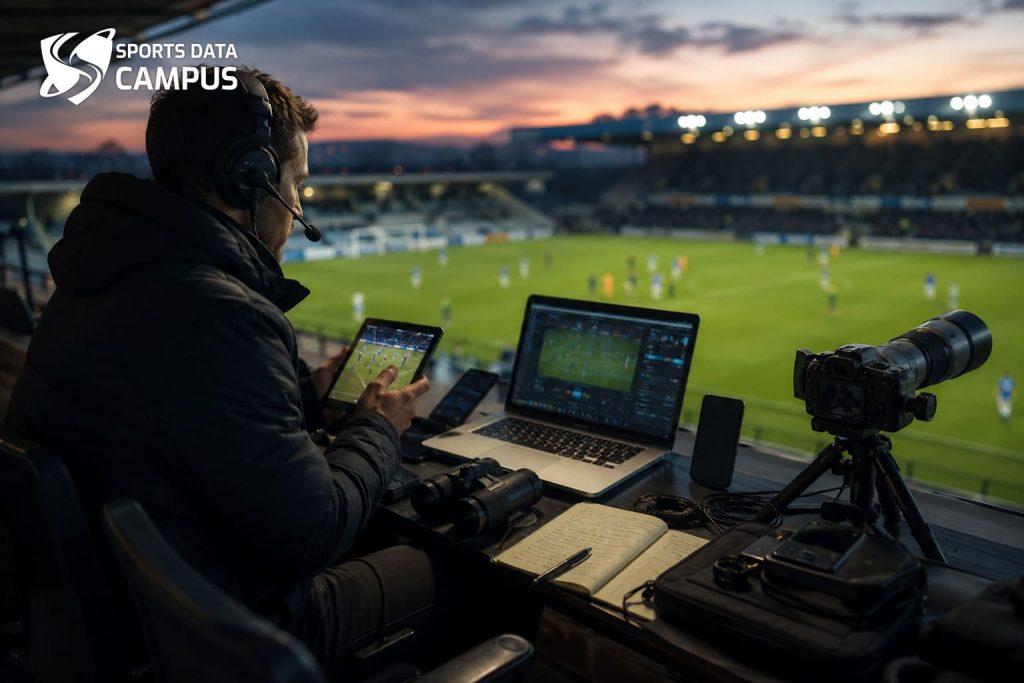
Technological advances have transformed drones used in football from manually controlled tools into autonomous systems capable of recording and processing information in real time. This represents a major change in the way training sessions and matches are analysed, as it reduces reliance on an operator and enables more consistent and accurate capture of movement across the pitch.
An autonomous drone is designed to follow the action automatically, adapting to the speed and direction of the ball or the players. This is made possible by Artificial Intelligence and computer vision, which help maintain a stable frame without losing detail, even during high-intensity phases of play. In practice, this provides consistent, high-quality video footage without interruptions.
The real value comes when this footage is connected to sports analysis platforms. The data collected can be integrated directly with specialised software, generating metrics such as distance covered, movement speed and space occupation. This gives coaching staff access to real-time information that can support decision-making during training sessions.
Another advantage is greater resource efficiency because clubs do not need a dedicated pilot, which can help reduce costs and minimise human error. Autonomous operation can also make drone technology easier to use across different levels of the game, from professional football to academy development.
In short, autonomous drones not only improve recording quality, but also turn data collection into a more automated and continuous process, changing the way tactical and physical analysis is carried out in football.
What advantages do drones offer over other sports analysis technologies?
The use of drones in football has not only opened up new possibilities for observation and analysis, but has also highlighted several advantages over traditional technologies such as fixed cameras and wearable tracking systems. Although these alternatives remain useful, they have limitations that drones can overcome in different ways.
- First, drones offer greater freedom of movement. While cameras installed on towers or in the stands depend on a fixed angle, drones can follow the action from different perspectives and adapt to the pace of a training session or match. This makes it possible to capture dynamic information that reflects what is happening on the pitch more accurately.
- Another important advantage is cost-effectiveness. Tracking systems based on wearable sensors require each player to use specific devices, which involves investment in hardware and ongoing maintenance. Drones, by contrast, can record the collective and individual behaviour of the entire team in a single session, reducing both costs and preparation time.
- Their ability to integrate with analysis software is another key benefit. By generating high-quality aerial footage, drones can be synchronised with video analysis tools that process information on positioning, transitions and distance covered. This integration turns visual information into actionable metrics for coaches and analysts.
- Finally, drones used in football offer considerable versatility. They can support tactical analysis, physical preparation and youth player development, while also adding value to broadcasting and scouting.
Overall, drones combine mobility, data quality and accessibility in a way that helps overcome some of the limitations of previous technologies, making them one of the most versatile tools available for football analysis.
How do drones improve physical monitoring and injury prevention?
Drones in football not only provide advantages for tactical analysis, but can also be a valuable tool for assessing players’ physical performance. Thanks to their aerial tracking capabilities, they can record workload-related movement patterns and provide information that complements other monitoring systems.
- One of their main applications is measuring movement and speed, as drones can show how physical effort is distributed throughout a session, distinguishing between high-intensity runs, changes of pace and recovery phases. This helps fitness coaches design training sessions that are better suited to both individual and collective needs.
- Another key use is monitoring spatial occupation. By viewing from above the areas covered by each player, coaching staff can identify imbalances in the distribution of effort, which can help manage overload and reduce injury risk.
- Drones also make it easier to compare performance over time. By reviewing footage from different sessions, it is possible to analyse a player’s development and assess changes in endurance, reaction speed or recovery efficiency.
- In youth football, drones can be particularly useful because they allow coaches to evaluate the progress of young players in real game situations, combining physical analysis with a broader understanding of tactical behaviour.
Overall, drones have become a valuable tool that complements traditional metrics by providing a broader and more objective view of physical performance. Their integration into the daily work of clubs represents a step forward towards more efficient, safer and more personalised training.
Drones have become a strategic resource that strengthens the working methods of coaching staff and adds significant value to the overall management of a football club.
Limitations and challenges of using drones in football
Although drones in football have proved to be highly valuable tools, their implementation still faces several limitations and challenges that can restrict widespread adoption across clubs and academies.
One of the main obstacles is the regulatory framework, as many countries have strict rules governing the use of drones in open spaces. This often means obtaining specific permits and complying with flight restrictions, which can limit their use during official matches or at facilities located in urban areas.
Another challenge is the initial investment and ongoing maintenance costs. Although drones can be more affordable than some other technologies, high-end models and autonomous systems still require significant financial resources. This can put them beyond the reach of smaller clubs or development academies. Additional costs may also include analysis software and staff training.
The learning curve is another important factor. Recording footage is not enough. Clubs need to interpret it correctly and turn it into useful information, which means having analysts who understand how to combine video with data in order to make the most of the technology.
There are also technical limitations, including battery life, which restricts recording time, and weather conditions that can affect flight stability. In highly competitive environments, questions also remain around the reliability of live use.
Overall, drones offer considerable potential for football, but full integration requires clubs to overcome legal, financial, technical and training-related challenges. Those that adapt successfully will be in a stronger position to make the most of this technology as the game continues to evolve.
The introduction of drones used in football has changed the way clubs plan training sessions, analyse performance and develop strategies. Their ability to provide a complete view of the game, capture real-time data and complement other analysis systems makes them one of the most influential technologies in the sport.
Beyond their tactical and physical applications, drones provide strategic value by supporting innovation across clubs at different levels. However, unlocking their full potential depends on having professionals who know how to combine visual information with data analysis and decision-making.
Take your passion for analysis to the next level! The Master’s Degree in Football Analysis prepares you to work with drones, advanced metrics and cutting-edge technology in professional football.
Fill in the form below to learn how to analyse football by combining game analysis, video analysis and data analysis with the Master’s Degree in Football Analysis