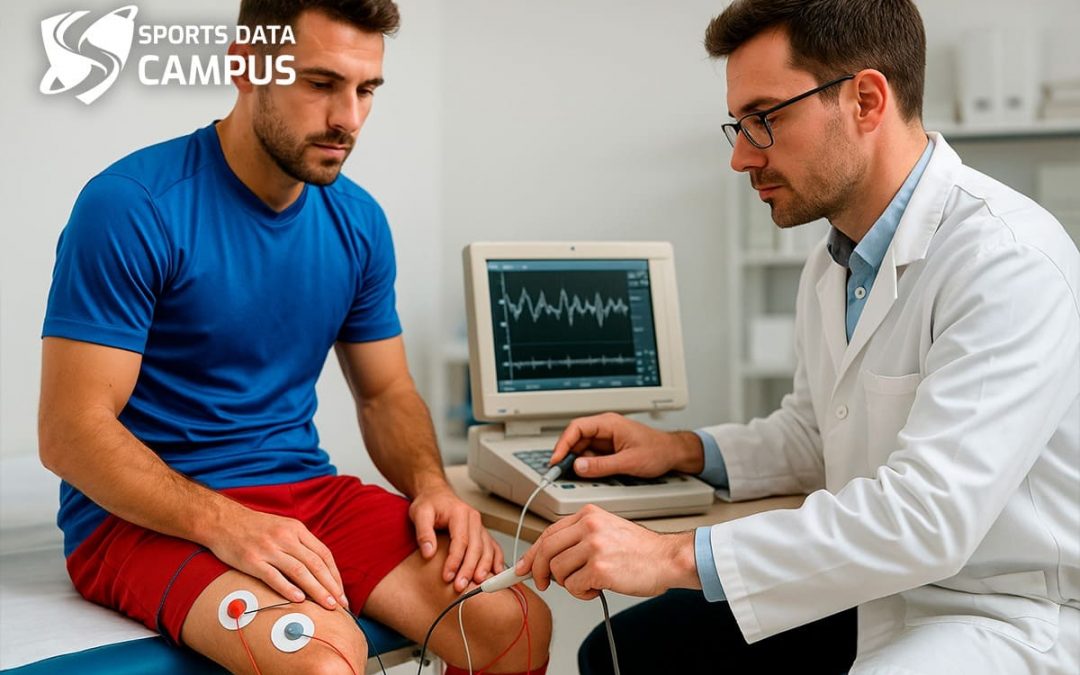
Surface electromyography (EMG) applied to the performance of football players is an essential tool for optimising their physical preparation. With this technology, coaches and specialists can analyse muscle activation in real time, spot functional imbalances, prevent injuries and fine-tune training loads with real precision. Bringing EMG into the daily routine of clubs and rehab staff allows decisions to be made from objective data, boosting both individual and collective performance.
In this article, we’ll look at how EMG works, the type of information it provides and why it has become an indispensable resource for any football professional who wants to bring a scientific approach to muscle work.
Surface electromyography applied to performance in football players. What it is and why it’s key in modern football
Surface electromyography applied to the performance of football players makes it possible to measure muscle activity in a non-invasive way and in real time. In football, this technology offers a detailed view of the athlete’s neuromuscular function, revealing imbalances, compensations or deficits that would be impossible to detect with the naked eye.
Unlike other techniques, surface EMG provides precise data on when, how much and in what way a muscle activates during a technical action or functional task. This information is crucial for designing more effective training sessions, preventing injuries and making individualised decisions that genuinely influence performance at elite level.
Its integration with digital analysis platforms also makes it possible to record, compare and visualise each player’s progression, fully aligning with the data-driven approach demanded by high-performance sport today.
How muscle activity is measured and what data it provides
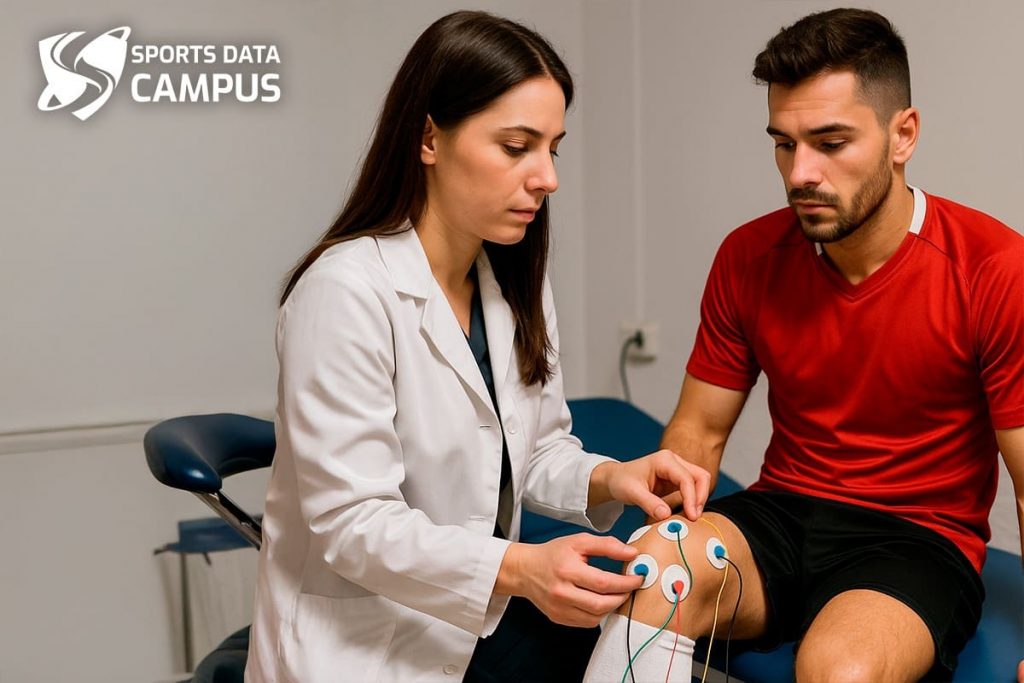
This measurement is based on placing adhesive sensors on the skin, directly over the muscle belly, which makes it possible to collect electrical signals that reflect the athlete’s neuromuscular activation in real time. Thanks to technologies such as the Endurance platform, the analysis becomes intuitive, portable and accessible for the coaching and medical staff.
The data obtained shows how the muscular system responds to different functional tasks, from isolated movements to actions that replicate real match situations. This completely changes the way training and recovery processes are planned, corrected and evaluated.
How the electromyograph works: sensors, patches and mobile app
The measurement system uses a small wireless device that attaches to a patch placed on the skin. This sensor captures the electromyographic signal and sends it via Bluetooth to a connected mobile application. From there, the practitioner can monitor muscle activity in real time through different types of graphs.
This compact design allows measurements to be taken directly on the pitch, during real training scenarios or specific functional tasks, without the need for complex setups or closed laboratory environments. The mobile app also provides a clear visual interface for both staff and players, making instant biofeedback easy to understand and apply.
Using tools such as surface electromyography applied to the performance of football players requires a blend of technical skills, data-interpretation ability and a deep understanding of human movement.
Types of graphs obtained and how to interpret them
The electromyograph generates a series of graphs that make it easier to understand muscle activity in a clear and visual way. Among the most relevant are:
- RMS (Root Mean Square) graphs: Show the intensity of muscle activation in microvolts. They are used to compare activation between muscles or between sides of the body.
- Symmetry comparisons: Help identify differences in activation from one side of the body to the other, which is key for injury prevention.
- Muscle synergy analysis: Detect whether the muscles that should work together are activating correctly or whether compensations are taking place.
- Baseline tone measurement: Captures the level of muscle activation at rest, identifying abnormal tension.
All these graphs can be viewed during the test or stored for later analysis.
The cloud laboratory. From raw data to a clinical–sport report
One of the major advantages of this technology is the ability to work with a cloud platform that stores, organises and analyses the data collected by the sensors. At the end of each session, the recordings can be synchronised automatically with the practitioner’s account, generating reports with comparative tables, progression charts and personalised recommendations.
This digital infrastructure not only saves time but also allows the technical staff to access the data from anywhere, share it with other members of the team or integrate it into a broader physical-analysis system. In this way, a player history is built from quantifiable evidence, fully aligned with the principles of Big Data applied to sports performance.
Key variables for assessing muscle performance in football players
Surface electromyography applied to the performance of football players not only makes it possible to visualise muscle activity in real time, but also helps identify fundamental variables that influence the efficiency of technical actions, motor control and injury prevention. These variables give the coaching and medical staff objective evidence that supports individualised decisions based on data rather than simple observation or intuition.
A detailed analysis of these variables becomes a competitive advantage both in physical preparation and in injury rehabilitation, as it provides an accurate picture of the player’s neuromuscular function at every stage of the process.
Resting baseline tone. Detecting non-functional tension
One of the major advantages of surface electromyography applied to the performance of football players is the ability to measure baseline muscle tone at rest. This measurement makes it possible to detect residual activation that reveals unnecessary sustained tension, usually linked to compensations, accumulated fatigue or poor neuromuscular inhibition.
Identifying this type of tension is key to designing interventions that restore the muscle to its optimal resting state and promote a more efficient and economical movement pattern.
Asymmetries between contralateral muscles
Comparative analysis between the right and left sides of the body makes it possible to identify asymmetries in muscle activation. These differences may be related to previous injuries, excessive dominance or compensations caused by functional imbalances.
EMG provides precise quantification of these asymmetries, allowing practitioners to adjust training loads, modify exercises or introduce neuromuscular rebalancing tasks based on objective data.
Altered muscle synergies
During functional movements, muscles do not work in isolation; they operate in synergy. When this coordination is disrupted—whether due to fatigue, injury or an incorrect learned pattern—compensations appear that affect performance and increase the risk of injury.
EMG technology makes it possible to see whether the muscles that should activate together are doing so with the correct intensity and timing. Detecting altered synergies is essential for readapting technical actions and retraining motor control.
Activation deficits
Some muscles show deficits in their ability to activate voluntarily, meaning they are not being recruited efficiently during a given task. This may be caused by reflex inhibition, poor neuromuscular connection or technical issues within the movement itself.
With surface electromyography applied to the performance of football players, these deficits can be visualised, addressed through specific work and monitored throughout the training or rehabilitation process.
Excess compensatory coactivation
Another key variable is the excessive coactivation of antagonist or non-desired muscles during movement. This occurs when, due to fear, lack of confidence or compensatory strategy, the player activates muscles that should remain inhibited.
Through EMG analysis, this coactivation can be detected and exercises can be designed to help the player trust the correct pattern, reducing unnecessary tension and improving movement efficiency.
The physical preparation of the future requires professionals trained in technology, data analysis and functional knowledge, capable of connecting movement science with the competitive reality of football
Practical cases and technical decisions based on EMG
Surface electromyography applied to the performance of football players provides decisive data to guide technical decisions during physical preparation and injury rehabilitation. Real-time analysis of muscle activation makes it possible to detect deficits, imbalances or altered synergies that would go unnoticed through traditional observation. With this information, the technical staff can adjust exercises, loading progressions and execution patterns according to the player’s individual neuromuscular response.
Comparing recordings before and after an intervention also makes it possible to evaluate the true effectiveness of the work carried out. This quantifiable evidence transforms the training process, as decisions are based on objective data rather than perceptions. This functional and data-driven logic is central to the approach required in modern high performance and aligns with the competencies developed by professionals trained in physical analysis with advanced technology and Big Data tools.
Biofeedback as a tool for individualised training
One of the most powerful advantages of surface electromyography applied to the performance of football players is the ability to offer real-time biofeedback. By instantly visualising muscle activation on an app or screen, the player becomes directly aware of which muscles are activating, with what intensity and at what moment of the movement. This immediate feedback improves adherence, facilitates voluntary correction of the motor pattern and accelerates functional re-education.
With biofeedback, the physical coach guides the athlete to selectively activate a weak muscle, inhibit one that should not be involved or restore altered synergies. It also allows exercises to be adapted in real time depending on the goal, whether increasing activation, seeking symmetry or reducing compensatory coactivation. This level of personalisation and control is key to optimising training efficiency, especially in sensitive phases such as prevention or return to play.
Advanced applications – From technical action to functional action
Electromyography goes beyond simple muscle measurement in static exercises. Its integration into football-specific movements—such as sprinting, jumping or changing direction—enables phase-by-phase analysis (concentric, eccentric and isometric), revealing how muscles behave in high-demand functional situations. This detailed view of the real gesture provides crucial information to assess movement quality, neuromuscular efficiency and injury risk in each specific action.
It is also possible to analyse activation ratios between synergistic and antagonist muscles and compare activation patterns between both sides of the body during dynamic tasks. This helps detect technical deviations linked to functional deficits, intervene specifically and validate the effectiveness of the correction. The connection between technical action and motor control becomes tangible and measurable, turning this tool into an essential resource for high-level functional work in football.
Why the future of physical performance lies in muscle data analysis
Muscle data analysis has become a fundamental piece of modern sports performance. Surface electromyography applied to the performance of football players turns intuition into measurable information, and this into personalised decisions. Its integration with analysis platforms, cloud environments and visualisation tools turns the physical coach into a true manager of functional data. This not only optimises injury prevention and technical improvement, but also opens the door to predictive models based on machine learning and longitudinal analysis.
This technological and methodological ecosystem is one of the core areas covered in the Master’s in Big Data applied to physical preparation in football, training professionals capable of integrating sensors, data and strategic decision-making within high-performance environments
As clubs move towards standardised protocols, systematic data collection and full traceability of every intervention, it becomes essential to have professionals capable of interpreting this information with both technical and clinical insight. The challenge is no longer just measuring, but knowing what to do with the data.
Key training to master this technology in football
Using tools such as surface electromyography applied to the performance of football players requires a blend of technical skills, data-interpretation ability and a deep understanding of human movement. It is not enough to obtain graphs; those graphs must be translated into practical decisions, dysfunctional patterns need to be identified, personalised interventions must be designed and every adjustment must be backed by scientific reasoning. This demands specialised training that brings together physiology, biomechanics and data analysis within a single learning environment.
The Master’s Degree in Sports Science and Data Intelligence in High-Performance provides that solid foundation. Through hands-on work with real tools such as Endurance, practical cases taken from professional football and expert guidance, students acquire the skills needed to integrate advanced technologies into their daily methodology. It is a programme designed for those who want to lead the shift towards a data-driven, evidence-based and functionally informed approach to physical preparation with a direct impact on sporting performance.
Request more information using the form below.