
The use of Python for football analysts has completely transformed the way data is understood and applied in the sport, as well as how repetitive manual tasks are automated. From professional clubs to independent analysts, more and more people are adopting this programming language as a key tool to explore performance, predict behaviours and make evidence-based decisions. Python stands out for its clear syntax, its ecosystem of specialised libraries and its strong ability to connect with multiple data sources.
Today, tactical analysis, player evaluation, scouting, visualising playing patterns and even injury prevention all rely on Python-based tools. It also automates things like downloading the same files from different platforms, transforming datasets or updating reports — cutting tasks that used to take an hour or more down to a single click. Knowing and mastering this language has become an essential skill for anyone who wants to influence the present and future of professional football.
Is Python used in sports analytics?
Yes, Python is widely used in sports analytics thanks to its flexibility, processing power and ecosystem of specialised libraries. It’s the ideal tool for turning large volumes of data into clear, useful information for coaches, players and decision-makers. And with modern code-assistant tools, it’s accessible to any professional.
In sports like football, Python allows analysts to examine performance statistics, automate data-collection processes and build predictive models that anticipate results, injuries or fitness levels. Libraries such as Pandas, NumPy and Matplotlib make data exploration and effective visualisation much easier, supporting technical decision-making across the board.
It’s also used in tactical evaluation through video analysis and positional tracking, using technologies like OpenCV. Many clubs integrate it into their workflows to monitor physical and technical performance in real time.
Python can also connect multiple data sources — APIs, databases, sensors — into a single environment, multiplying the value of the information. And thanks to its global community, improvements and solutions can be shared and adapted to any sporting context. Python is, without a doubt, the language driving the current analytics revolution in sport.
Today, tactical analysis, player evaluation, scouting, visualising playing patterns and even injury prevention are all supported by Python-based tools.
Advantages of using Python for sports analysis
Python offers a powerful, accessible and adaptable environment that makes it the ideal tool for anyone working with data in sport. These are its main advantages:
- Clear and easy-to-learn syntax: Perfect for both technical and non-technical profiles, allowing you to focus on analysis without needing to be an expert programmer.
- Large ecosystem of libraries: Tools such as Pandas, NumPy, Matplotlib or Scikit-learn cover the entire analytical cycle, from data collection to prediction.
- Automation of repetitive tasks: Save time by creating scripts that clean data, generate reports or gather statistics automatically.
- Strong and intuitive data visualisation: Easily create charts, heatmaps or interactive dashboards to communicate insights.
- High compatibility and integration: Connect effortlessly with APIs, databases, spreadsheets or sports platforms.
- Advanced predictive capability: Build models that anticipate injuries, performance levels or tactical outcomes.
- Active and growing community: A global network of users who share solutions and useful resources for sports analysts.
- Generative AI tools: They make writing code almost feel secondary — you simply focus on the process and the purpose of the task.
How is Python used in football?
The use of Python for football analysts has become standard across technical and data departments in professional clubs. Its applications range from statistical processing to tactical analysis and strategic decision-making.
One of the most common uses is performance evaluation. With libraries such as Pandas and NumPy, analysts study individual and collective statistics across matches or full seasons. They also build models that predict player and team behaviour in specific situations.
Python is also widely used to extract information from video and positional data, making tactical analysis easier through images, heatmaps or spatial patterns. On top of that, it supports automated technical reports and scouting processes by analysing performance data from lower leagues.
By integrating sources such as databases, GPS sensors and APIs, Python allows clubs to unify their entire information ecosystem. In short, it not only helps to analyse — it helps to structure, connect and turn data into valuable football decisions.
Player and team performance analysis
A key pillar of using Python in football analysis is the detailed study of both individual and collective performance. With large datasets collected from matches, training sessions and tracking devices, analysts can identify patterns that make a real competitive difference.
- Individually, metrics such as goals, assists, passing accuracy, duels won, offensive contribution or ball recovery are evaluated. With Python, this data is easy to structure and compare between players or against performance standards, even when using advanced stats such as xG or xA.
- Collectively, teams are assessed through tactical efficiency, attacking production, defensive solidity or control of the game’s tempo. Visualisations such as heatmaps, passing networks or space-occupation graphics help explain team dynamics in a clear way.
Libraries like Seaborn and Matplotlib make it simple to present these insights to coaching staff. Python doesn’t just uncover what happens on the pitch — it turns it into targeted improvement plans and more effective decisions.
Predictive modelling in football
One of the most powerful uses of Python for football analysts is building predictive models capable of anticipating what may happen in the game. Thanks to machine learning, analysts develop algorithms that detect complex patterns and generate predictions based on historical data.
These models can predict match outcomes, physical performance trends or injury risk by considering variables such as physical condition, accumulated minutes, position or match context. Tools like Scikit-learn, TensorFlow and XGBoost allow these models to be trained with high accuracy.
Scenario simulations and tactical adjustments are also possible. For example, a model can estimate the probability of conceding a goal if the team loses the ball in a specific zone of the pitch.
This shift from intuition to predictive knowledge is reshaping modern football. Python provides the perfect environment to build these solutions, which are increasingly used by elite clubs and advanced coaching staff.
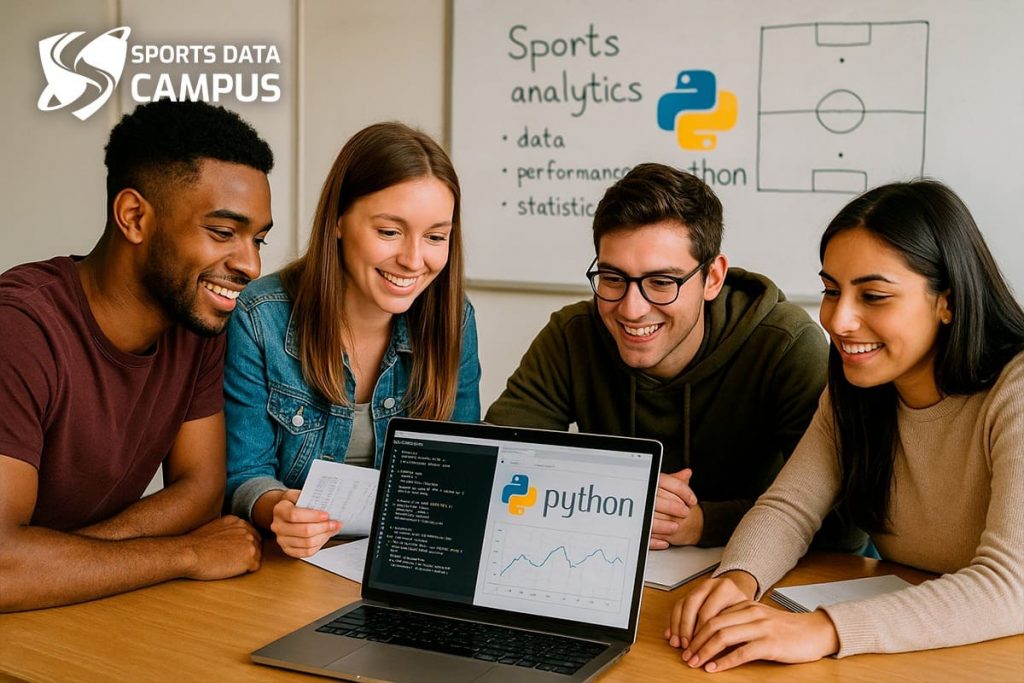
What does a data analyst do with Python?
The work of a data analyst in football revolves around turning information into decisions — and Python is their main tool. This language makes it possible to automate processes, analyse large amounts of data and create visualisations that make even the most complex analyses easy to understand.
A football analyst gathers data from multiple sources such as tracking systems, statistical platforms, GPS sensors or video files. With Python, they clean and structure this information, identify trends, build predictive models and produce technical reports that support both coaching staff and the sporting department.
They also contribute to tactical preparation, opponent scouting and injury prevention, all supported by scripts, interactive dashboards and environments like Jupyter Notebook. Their role is no longer secondary — it has become essential within any professional football structure.
Analysts who master Python for football analysis are increasingly sought after, whether in top-tier clubs, academies, sports-tech startups or specialist media.
Process automation
Automating tasks is one of the biggest advantages of using Python for football analysis. Thanks to its flexibility, analysts can create scripts that gather data from multiple sources — APIs, spreadsheets or tracking platforms — without any manual action.
This makes it possible to generate automatic post-match reports, feed dashboards with real-time data or clean large datasets with a single line of code. Alerts can also be programmed to detect performance anomalies or situations that require immediate tactical attention.
Python helps analysts save time, reduce human error and maintain consistency across their reports — a key factor for reliable decision-making throughout the season.
Data visualisation and data-driven decision-making
Data means nothing if it cannot be understood. That’s why visualisation is a pillar of using Python in football analysis. Tools such as Matplotlib, Seaborn or Plotly turn tables and models into clear, intuitive and tailored graphics.
These visualisations help uncover patterns that aren’t visible at first glance: heatmaps, passing networks, performance curves, positional comparisons or scatter plots, to name a few. All of this is shared through interactive dashboards that coaching staff use every day.
Effective visualisation speeds up understanding, strengthens collaboration between analysts, coaches and performance staff, and improves communication across the club. Python turns data into decisions.
Analysts who master Python for football analysis are increasingly in demand, both in top-tier clubs and in academies, sports-tech startups and specialist media
Python tools and libraries for football analysts
One of the reasons why Python is so powerful for football analysts is its ecosystem of specialised libraries. Every stage of the analysis — from data collection to visualisation and modelling — has tools designed to make the analyst’s work easier.
Recommended libraries
- Pandas: For manipulating and analysing tabular data using DataFrame structures. Ideal for working with match or player statistics.
- NumPy: Efficient numerical computing. Perfect for vectorised operations, physical-performance analysis and per-minute metrics.
- Matplotlib and Seaborn: Data visualisation. Allow you to create anything from simple charts to complex heatmaps showing action zones, trajectories and playing patterns.
- SciPy and Statsmodels: Advanced statistical analysis. Useful for hypothesis testing, correlations or regression analysis related to performance.
- Scikit-learn: Supervised and unsupervised machine learning. Used to build predictive models for results, injuries or expected performance.
- TensorFlow and Keras: Deep learning for large-scale datasets such as video tracking or complex signal processing.
- OpenCV: Video and image processing, widely used for tactical analysis based on match footage.
- GeoPandas: For spatial analysis, ideal for tactical maps and positional studies.
- BeautifulSoup and Scrapy: Web scraping tools to gather real-time data from sports websites or public databases.
Integrating Python with other analysis tools
- SQL connectors, sports APIs (Opta, StatsBomb) and spreadsheets in Google Sheets or Excel.
- Interactive dashboards built with Plotly, Bokeh or Dash.
- Collaborative environments such as Jupyter Notebook or Google Colab.
Together, these tools make Python a complete and adaptable environment for the daily work of football analysts.
The future of Python in football analysis
The evolution of data analysis in football is closely linked to the growing use of Python. What used to be a competitive advantage is now a strategic necessity. Python for football analysts is no longer just a trend — it has become the standard across clubs, sports-tech startups and tactical innovation projects.
New generations of analysts are being trained in machine learning, automation and data science — and Python is the gateway to all of these disciplines. Its ability to process real-time data, build complex predictive models and visualise large volumes of information places it at the heart of the sport’s digital ecosystem.
On top of that, its integration with emerging technologies such as biometric sensors, video tracking, augmented reality and neural networks opens the door to new possibilities for evaluating performance, predicting scenarios and designing hyper-personalised strategies.
In a competitive environment where every detail matters, those who master Python stay one step ahead. That’s why the Máster´s Degree in Advanced Python Applied to Football is the ideal programme — it trains the professionals who will lead the future of sports analysis with cutting-edge tools, real projects and top-level mentors.
Fill in the following form to receive more information about the Máster’s Degree in Advanced Python Applied to Football and about our international scholarship programme here: