This ranking acts as a career guidance tool. It helps identify the different roles within the sports data ecosystem, the responsibilities involved in each position and the skills worth developing to move towards each career path. The key is to understand the sector clearly, choose a realistic route and build projects that show an ability to turn sports data into useful decisions.
Sports Data Career Opportunities
Which Sports Data Career Opportunities Match Your Profile?
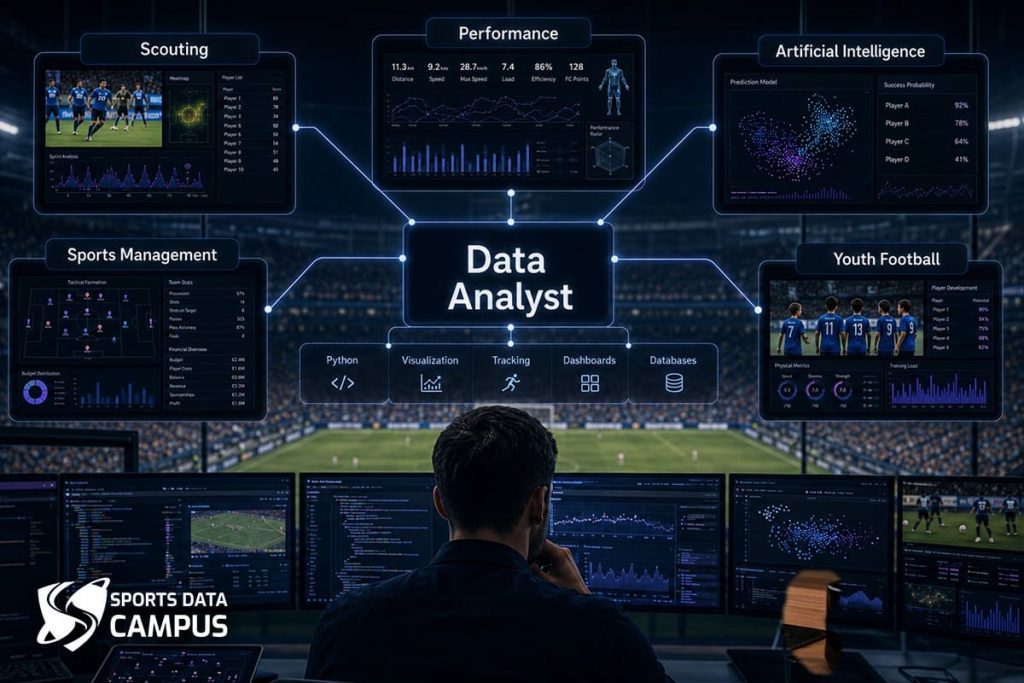
Comparing sports data career opportunities makes it easier to choose the right path with confidence. Each role requires different responsibilities, skills and entry-level experience. Some career paths focus on performance analysis and scouting, while others specialise in engineering, artificial intelligence, business or data leadership. The table below highlights the key differences to help you identify the option that best matches your background and career goals.
Tactical Analysis, Competition and Talent
The tactical analysis, competition and talent category brings together the sports data career opportunities that are closest to match analysis, scouting, youth development and sporting management. In these roles, data is used to interpret performance, identify tactical patterns and turn observation into objective, comparable insights.
Professionals in this area work with match data, video analysis, tracking data and scouting metrics, but they also need a strong understanding of playing styles, competitive context and each player’s role within the team. Tactical analysts, video analysts, Data Scouts and youth academy analysts combine football knowledge, technology and the ability to communicate actionable insights that support match preparation, talent identification and player development.
Tactical and Performance Data Analyst
A Tactical and Performance Data Analyst connects tactical understanding with quantitative evidence. Their role is to analyse team behaviours, individual actions, phases of play and performance metrics to help the coaching staff make better-informed decisions.
Their main responsibilities include:
- Analysing tactical patterns of both their own team and the opposition.
- Studying phases of play such as build-up, pressing, transitions and finishing.
- Combining event data, video, tracking data and physical performance metrics.
- Producing pre-match and post-match reports for the coaching staff.
- Identifying performance trends by player, position or competitive context.
- Turning complex data into clear, actionable insights that can be applied on the training pitch.
Integrated Data Video Analyst
An Integrated Data Video Analyst combines visual match analysis with event data, tactical metrics and competitive context. Their work helps the coaching staff review key moments, identify recurring patterns and explain performance through a combination of video clips, data and football expertise.
Their main responsibilities focus on turning video into actionable insights:
- Tagging key actions from both their own team and the opposition.
- Linking match clips with performance metrics.
- Analysing phases of play such as pressing, progression, organised defending and transitions.
- Preparing short video presentations for players and coaching staff.
- Identifying behaviours that are not immediately visible in statistical reports.
- Organising video libraries for tactical analysis and player development.
Data Scout or Talent Recruitment Analyst
A Data Scout or Talent Recruitment Analyst combines data, video analysis and football expertise to identify players who fit a specific recruitment need. Their role helps narrow large talent pools, compare player profiles and reduce bias before progressing to in-depth live or video scouting.
Their main responsibilities focus on structuring the recruitment process:
- Defining recruitment profiles based on position, age, role and playing style.
- Filtering players using performance metrics and competitive context.
- Comparing players across leagues, minutes played, quality of opposition and team playing style.
- Building shortlists for scouting and sporting departments.
- Combining data with video analysis to validate on-pitch behaviour.
- Identifying undervalued players and those with strong development potential.
Youth Development and Academy Methodology Data Analyst
A Youth Development and Academy Methodology Data Analyst works with information on young players to support their sporting development. Their role connects performance, the development process and decision-making, always considering the player’s age, competitive environment and stage of development.
Their main responsibilities help structure the monitoring of internal talent:
- Analysing player development by age, position and stage of progression.
- Creating technical, tactical, physical and competitive development indicators.
- Comparing performance across age groups without losing sight of maturation.
- Supporting decisions on promotion, loan moves or continued development within the academy.
- Identifying gaps between a player’s current level and the target profile.
- Producing reports for methodology teams, coaches and academy management.
Engineering, Data Architecture and Applied AI
Engineering, data architecture and applied AI bring together the sports data career opportunities that build the technical foundations of sports analytics. These professionals connect data sources, automate workflows, design data models and develop solutions for performance analysis, scouting, data visualisation and sports technology products.Their work involves organising information from matches, tracking systems, video, physical workloads and business operations, while ensuring data quality, traceability and reliable access. Data engineers, data scientists and BI specialists combine programming, statistics, machine learning and data visualisation to turn scattered data into useful systems for clubs, federations and sportstech companies.
Sports Data Architecture Engineer
A Sports Data Architecture Engineer designs the technical structure needed to capture, organise and connect information from different sources. Their work supports every stage of analysis, as clean, traceable and well-structured data is essential for building reliable reports, models and dashboards.
Their main responsibilities focus on creating a solid data foundation for the sports data ecosystem:
- Integrating sources such as match data, tracking, scouting, video, physical workload and business information.
- Designing pipelines to capture, clean, transform and store sports data.
- Creating data models that make analysis easier for other specialists.
- Ensuring data quality, consistency and traceability.
- Automating processes to reduce manual errors and save time.
- Connecting databases with BI tools, notebooks and internal platforms.
Sports Data Scientist or AI Modelling Specialist
A Sports Data Scientist or AI Modelling Specialist uses statistical models, machine learning and advanced analytics to forecast scenarios, identify patterns and generate predictions for sport. Their role is not simply to apply algorithms, but to translate sporting questions into practical, measurable models that support decision-making.
Their main responsibilities focus on predictive analytics and automation:
- Developing models to predict performance, player development and competitive risk.
- Analysing large datasets from match events, tracking, scouting and physical performance.
- Designing variables that better represent the sporting context.
- Evaluating model performance and limitations before applying results to real-world decisions.
- Automating analytical workflows using Python, notebooks and internal systems.
- Communicating complex findings clearly to both technical and sporting stakeholders.
Sports BI and Data Visualisation Specialist
A Sports BI and Data Visualisation Specialist turns complex information into clear dashboards, reports and visualisations that support decision-making. Their role is essential when a club, federation or sportstech company needs fast, organised access to performance, scouting, business or audience metrics.
Their main responsibilities focus on transforming data into visual insights:
- Designing dashboards with relevant sports performance indicators.
- Creating automated reports for coaching staff, management and business teams.
- Defining clear KPIs based on the objectives of the analysis.
- Connecting databases with tools such as Power BI, Tableau and Looker Studio.
- Visualising trends in performance, workload, scouting and fan engagement.
- Presenting technical information through clear, accessible visualisations for non-technical audiences.
Physical Performance, Health and Availability
Sports data career opportunities linked to physical performance, health and availability focus on understanding how athletes respond to training, competition and accumulated workload. These professionals work with GPS data, external loads, perceived exertion, wellbeing questionnaires, minutes played and physical history.
Their role is to organise this information to support decisions on preparation, recovery, rehabilitation and player availability. Performance analysts, strength and conditioning coaches and sports science specialists combine physical data with competitive context to adjust workloads, identify meaningful changes and monitor athletes’ development more accurately.
Sports Science, Physical Performance and Load Analyst
A Sports Science, Physical Performance and Load Analyst works with data that helps explain how athletes respond to training and competition. Their role connects physical preparation, performance, recovery and availability, always taking into account the schedule, playing position, accumulated minutes and the player’s physical history.
Their main responsibilities focus on organising and interpreting athletes’ physical data:
- Analysing external loads through GPS, tracking and monitoring systems.
- Combining training, competition, wellbeing and recovery data.
- Identifying meaningful changes in intensity, volume and competitive exposure.
- Supporting decisions on planning, rehabilitation and gradual return to play.
- Producing reports for strength and conditioning coaches, physiotherapists and coaching staff.
- Identifying trends that help adjust workloads without compromising performance.
Business, Fan Engagement and Sports Markets
Sports data career opportunities linked to business, fan engagement and sports markets focus on analysing how fans, brands, clubs, leagues and digital platforms interact with the sports product. These professionals work with audience data, ticketing, CRM, sponsorship, digital engagement, marketing campaigns, sales and subscription data.Their role is to turn this information into commercial, product and fan relationship decisions. Business analysts, engagement specialists and quantitative professionals combine metrics, segmentation and market knowledge to interpret behaviour, identify opportunities and improve the fan experience across the sports ecosystem.
Sports Business Analyst or Business and Fan Engagement Analyst
A Sports Business Analyst or Business and Fan Engagement Analyst works with data related to audiences, revenue, fan behaviour and commercial performance. Their role helps clubs, leagues, federations and sportstech companies better understand how people interact with the sports product.
Their main responsibilities focus on connecting sports data with business decisions:
- Analysing attendance, ticketing, season tickets, campaigns and sales.
- Studying digital behaviour across websites, social media, apps and streaming platforms.
- Segmenting audiences by interests, habits and level of engagement.
- Measuring the impact of sponsorship activity, content and commercial campaigns.
- Creating dashboards for marketing, business, CRM and management teams.
- Identifying opportunities to improve the fan experience and support decision-making.
Quantitative Sports Data Analyst for Markets, Integrity and Betting
A Quantitative Sports Data Analyst for Markets, Integrity and Betting works with probability models, behavioural patterns and historical data to interpret regulated sports markets. Their role brings together statistics, risk analysis and competitive integrity through a responsible, evidence-based approach.
Their main responsibilities focus on analysing signals and probabilities:
- Modelling probabilities using historical data and contextual variables.
- Analysing unusual patterns in sports markets.
- Identifying deviations that may require an integrity review.
- Working with performance metrics, results, odds and market behaviour.
- Producing quantitative reports for risk, integrity and analytics teams.
- Assessing model reliability before applying it to sensitive decisions.
Sportstech, Product and Data Leadership
Sportstech, product and data leadership bring together roles that connect technology, strategy and management across sports data career opportunities. Their work involves turning the needs of clubs, federations, consultancies and technology companies into products, platforms, dashboards, analytics systems and more efficient processes.
These professionals need to understand the sporting challenge, organise the available data, coordinate technical teams and define how each solution should fit into day-to-day operations. Consultants, Product Managers and data leaders combine sporting knowledge, analytical judgement and strategic thinking to drive innovation projects, improve technology adoption and connect information with decisions across performance, business and management.
Technology Consultant or Sportstech Product Manager
A Technology Consultant or Sportstech Product Manager connects sporting needs with digital solutions. Their role involves understanding the real challenges faced by clubs, federations, academies and sports organisations, then turning them into products, processes or tools that improve analysis, management and decision-making.
Their main responsibilities focus on turning technology into practical value:
- Identifying needs across performance, scouting, youth development, business and management.
- Defining functional requirements for platforms, dashboards and digital products.
- Coordinating technical, sporting and business teams.
- Assessing sportstech tools based on usefulness, integration and real-world adoption.
- Prioritising product improvements using data, feedback and sporting objectives.
- Supporting digital transformation projects across sports organisations.
Head of Analytics or Sports Data Lead
A Head of Analytics or Sports Data Lead oversees the analytics strategy of a club, federation, league or sports organisation. Their role involves structuring processes, setting priorities, coordinating technical specialists and connecting data with decisions across performance, scouting, youth development, business and management.
Their main responsibilities focus on turning data into a clear working structure:
- Defining the organisation’s sports data strategy.
- Coordinating analysts, data scientists, BI specialists and external teams.
- Establishing shared metrics across sporting and business departments.
- Ensuring data quality, traceability and consistent use across the organisation.
- Prioritising analytics projects according to impact and available resources.
- Communicating findings to senior management, coaching staff and department leads.
Download the Complete Guide to Sports Data Career Opportunities
Now that you know the main sports data career opportunities, the next step is identifying which path best matches your background, interests and the skills you want to develop.
We’ve created a practical guide to help you compare the different career paths across the sports data ecosystem.
The guide includes:
- The main sports data career opportunities.
- The key responsibilities of each role.
- The most important skills for every position.
- The recommended entry level.
- Suggested first projects to build your experience.
- A clear roadmap to help shape your career in sports data.
If you want to discover which sports data career opportunity best matches your profile, complete the form below and download the SDC Sports Data Career Opportunities Map free of charge.