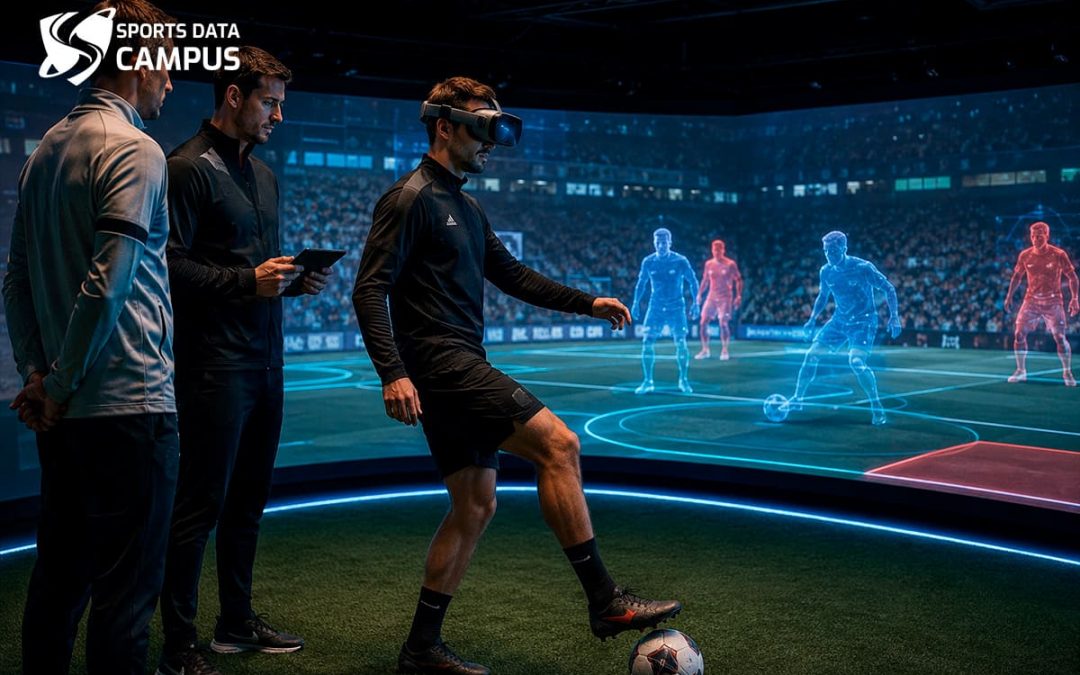
Virtual reality in football is transforming training by turning perception, decision-making and tactical reading into skills that can be developed in highly demanding simulated environments. Through immersive experiences, players face realistic situations with full control over the context, allowing them to repeat key actions and improve their response speed without increasing physical load.
This approach is reshaping sports preparation because it shifts the focus from physical execution to speed of thought. Virtual reality in football makes it possible to train the invisible processes of the game, measure behaviours and improve decision-making with precision, bringing technology, analysis and performance together into one coherent system.
How virtual reality training works in football
Virtual reality training in football is based on the integration of hardware, software and data to recreate game situations in controlled digital environments. Using VR headsets, players access three-dimensional scenarios where they can perceive depth, speed of action and distances with precision, helping them train decision-making in conditions very similar to a real match.
The key component is the software, which acts as the simulation engine. This system makes it possible to design specific tactical scenarios by adjusting variables such as opposition pressure, occupation of space, ball speed or the behaviour of virtual players. In this way, the use of virtual reality in football does not simply reproduce plays, but allows the context to be manipulated so specific responses can be trained within the team’s game model.
Virtual reality in football trains perception, decision-making and tactical reading in simulated environments, speeding up responses, measuring behaviours and optimising performance without increasing physical load
On top of this comes data analysis, which turns every interaction into useful performance insight. During the session, metrics such as reaction time, scanning frequency, decision quality and visual attention patterns are recorded. This information makes it possible to assess behaviours and fine-tune training with precision.
In addition, integration with analysis and video tools helps align virtual scenarios with real competitive situations. As a result, virtual reality is becoming a methodology that combines simulation, measurement and personalisation, making it possible to train the cognitive processes of the game in a systematic way that can be transferred to on-pitch performance.
What skills does virtual reality improve in football?
Virtual reality in football makes it possible to train skills that appear on the pitch in chaotic ways and are difficult to repeat. By controlling the environment and the variables of the game, players are systematically exposed to situations that develop both their technical ability and their tactical and cognitive intelligence. This approach turns decision-making into a trainable process, where every action can be repeated, analysed and optimised.
The main skills it helps improve include:
- Scanning and spatial awareness: Players improve their ability to identify relevant information before receiving the ball, widening their field of vision and reducing the time needed to process stimuli.
- Decision-making under pressure: Simulating situations with limited time and space forces players to choose the best options quickly, reducing mistakes in real match scenarios.
- Body orientation and positioning: Players train their body position before receiving the ball, helping them keep the play moving with smoother and more effective actions.
- Tactical reading and pattern recognition: Players identify defensive structures, passing lines and collective behaviours, improving their overall understanding of the game.
- Anticipation and timing of action: Repeating scenarios helps players adjust the exact moment to intervene, whether they need to pass, carry the ball or finish.
- Selective attention and focus management: Players improve their ability to prioritise relevant stimuli in environments with a high information load.
- Consistency in decision-making: Players maintain stable decision criteria even when variables such as pressure or game speed change.
This set of improvements positions the use of virtual reality in football as a key tool for developing skills that make a real difference to performance, especially in situations where action time is minimal and decision accuracy is decisive.
Immersive training and tactical simulation in football
Immersive training and tactical simulation in football turns complex game situations into controlled environments where players train decisions without depending on the on-pitch context. Virtual reality in football makes it possible to recreate specific scenarios with precise variations, making it easier to work on tactical patterns and individual responses within the team’s game model.
This approach does not aim to replace traditional training, but to optimise it. Simulation allows key actions to be repeated frequently, adjusting variables such as opposition pressure, occupation of space or the speed of the play. This improves tactical understanding and the speed of mental execution.
The most important applications include:
- Repetition of specific tactical scenarios: Training build-up play, progressions or finishing in defined contexts, with controlled variations that reinforce learning.
- Decision-making training in a realistic context: Players face dynamic situations where they must interpret the game and choose the best option based on their surroundings.
- Simulation of opposition behaviours: This makes it possible to prepare for matches by recreating the opponent’s tactical patterns, helping players anticipate and adapt strategically.
- Individual work by position: Each player trains situations linked to their specific role, improving specialisation and position-specific performance.
- Adjustment of training difficulty and progression: Changes can be introduced to the time available, the number of stimuli or the tactical complexity to raise the level of demand progressively.
- Training without additional physical load: Players can accumulate high-quality repetitions without physical impact, which is especially valuable during periods of heavy competition or recovery.
The combination of immersion and simulation turns virtual reality into a tool capable of accelerating tactical learning and improving decision quality, while becoming a strategic complement within modern football preparation.
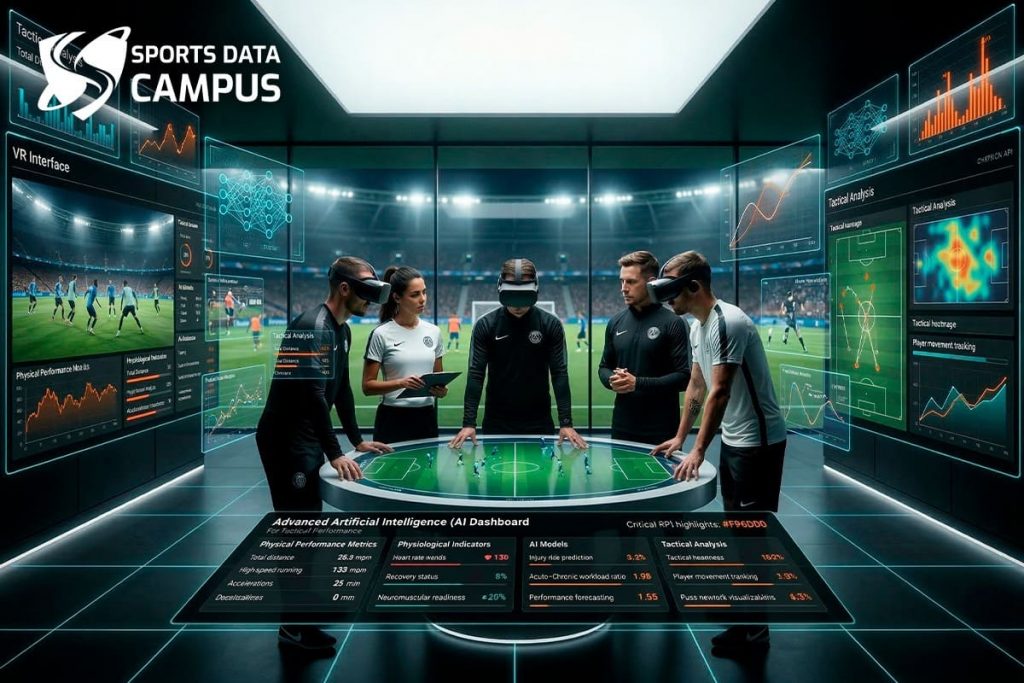
What is the impact of virtual reality on sports performance?
The impact of virtual reality is directly reflected in the improvement of processes that shape performance, especially those related to decision-making, perception and tactical consistency. Unlike other methods, VR makes it possible to train these areas in a specific, measurable and repeatable way, helping transfer them to the real game.
This approach leads to clear improvements in both individual and collective performance:
- Reduced decision time: Players process information faster, allowing them to act earlier and more effectively in pressure situations.
- Greater accuracy when choosing actions: The selection of passes, carries or finishes is optimised according to the tactical context.
- Improved consistency in play: Players maintain a more stable performance level even when match conditions change.
- Faster tactical adaptation: VR helps players assimilate new concepts and game models in less time.
- Direct transfer to on-pitch performance: Decisions trained in virtual environments are reflected in real situations, especially in highly demanding contexts.
- Optimised learning in academy and professional players: It helps speed up development in young players and maintain cognitive performance in elite players.
- Improved game reading under pressure: Players identify patterns and anticipate actions more clearly, reducing unforced errors.
In addition, virtual reality in football supports performance evaluation through objective metrics, allowing the coaching staff to identify areas for improvement and adjust training with greater precision.
This impact turns VR into a strategic tool within high performance, where the difference no longer lies only in physical ability, but in the capacity to make better and faster decisions in every action of the game.
Virtual reality tools applied to football
Virtual reality tools applied to professional football have evolved from basic visualisation solutions into advanced platforms capable of simulating tactical contexts, recording data and personalising training. Virtual reality in football is now integrated into performance, analysis and player development departments as an operational technology focused on improving decision-making and game understanding.
These tools are structured into different types depending on their functionality and level of complexity.
Video-based 360 platforms
These allow players to step inside real actions and work on perception, visual scanning and game reading from an immersive perspective.
One example is Rezzil, which recreates game scenarios to train decision-making in realistic contexts.
Interactive systems with tactical simulation
These use graphics engines to recreate dynamic scenarios where players make real-time decisions with variables such as pressure, space and game tempo.
For example, Be Your Best enables decision-making to be trained through personalised and measurable simulations.
Solutions with data and metrics integration
These record behaviours such as reaction times, attention patterns and decision quality, enabling precise performance analysis.
Sense Arena incorporates player behaviour tracking to assess and optimise decision-making in simulated environments.
Tools focused on position-specific training
These are designed to work on specific situations according to the player’s role, allowing for greater specialisation.
One example is Tactic3D, which makes it possible to train specific actions by position within personalised tactical scenarios.
Platforms connected to match analysis
These integrate real team or opposition data to recreate competitive contexts and prepare specific situations.
Rezzil Index allows teams to work on scenarios based on performance data and real competitive situations.
At implementation level, clubs prioritise technical factors such as tracking quality, system latency, simulation fidelity and personalisation capacity. Without these elements, the experience loses value and transfer to real performance is reduced. That is why virtual reality in football is not understood as an isolated tool, but as part of an ecosystem where video analysis, data and on-pitch work coexist.
Its use also requires a clear methodological approach. It is not enough to bring in technology. Clubs need to define what is being trained, how it is being measured and how it transfers to the real game. At this point, the role of the analyst and the coaching staff becomes decisive in turning VR into a tool for continuous improvement.
This scenario has created growing demand for profiles capable of understanding both technology and sports performance. Mastering simulation tools, interpreting metrics and designing data-based training sessions are now part of everyday work in professional clubs. That is why training in this field makes a real difference when accessing opportunities within the industry.
In this context, the Master’s in Artificial Intelligence Applied to Sport prepares professionals to work with these technologies, integrating data analysis, simulation and decision-making in high-performance environments. The programme covers everything from the use of tools to their strategic application within clubs, helping develop a profile aligned with the new demands of modern football.
Fill in the form and receive more information about the Master’s in Artificial Intelligence Applied to Sport.