

Advanced analytics in football is redefining how the game is understood and managed. Watching matches or relying solely on the coaching staff’s intuition is no longer enough. Data now makes it possible to assess every detail with precision and make evidence-based strategic decisions.
The use of Big Data has transformed key areas such as tactics, scouting, and physical performance. Through data analysis, clubs identify patterns, optimise training sessions, and spot opportunities that previously went unnoticed.
In this article, you’ll discover how advanced analytics works, the tools professionals use, and the impact it has on the evolution of modern football. To what extent are data changing the rules of the game?
What advanced analytics in football is and why it matters
Advanced analytics in football refers to the systematic use of data to understand, assess, and enhance every aspect of the game. It goes far beyond traditional analysis, which was limited to basic statistics such as possession or shots on goal. Today, professionals work with detailed, contextualised data that allow decisions to be made with an unprecedented level of accuracy.
This discipline combines technological tools with mathematical models to analyse patterns, predict behaviours, and optimise both individual and collective performance. Thanks to advanced analytics, it is possible to measure variables invisible to the naked eye, such as the spaces created by off-the-ball movement, the pressure applied in different areas of the pitch, or the efficiency of a defensive transition.
- Its usefulness is transversal. It helps design strategies, plan training sessions, identify talent, assess risks, and anticipate game scenarios. It also allows coaching staff to adjust tactical approaches based on real data, and enables clubs to make more accurate decisions regarding transfers or physical preparation.
- Moreover, it offers an objective view of performance. Coaches no longer depend solely on their perception but have concrete evidence to support their decisions. This improves communication with players and promotes a more professional approach to team management.
This discipline combines technological tools with mathematical models to analyse patterns, predict behaviours, and optimise both individual and collective performance
Advanced analytics has therefore become a fundamental pillar for any organisation seeking to compete at the highest level. Would you like to know how professional clubs apply it in their day-to-day work?
Real applications in professional clubs
Advanced analytics has already become part of the daily routine for many clubs, not only at elite level but also in intermediate divisions. Its application ranges from the micro analysis of an individual player to the macro perspective of the entire team, allowing decisions to be made on a much stronger foundation.
Some clubs have adopted a SWOT analysis model adapted to the sporting environment. Using this methodology, technical staff assess both their own strengths and weaknesses and those of their opponents, while also identifying opportunities and threats that may arise throughout the season. This framework enables more personalised strategies and quicker reactions to changes in the game.
Another common practice is the division between micro and macro analysis:
- Micro analysis focuses on individual details, such as a striker’s movements inside the box or a midfielder’s pressing ability.
- In contrast, the macro approach examines collective behaviour: The occupation of spaces, coordination between lines, risk zones, or the opponent’s defensive structure.
Clubs also use contextual analysis to assess specific performances based on the opponent, the moment of the match, or the tactical situation. In this way, data are not interpreted in isolation but linked to what actually happens on the pitch.
These applications not only improve technical decision-making but also optimise the process of preparation and performance evaluation.
The role of the football data analyst
The role of the data analyst in football has become an essential position within a club’s technical structure. Their work connects the pitch with the world of data, providing key information for coaches and sporting directors to make better decisions.
A data analyst does much more than interpret statistics. They study the game from a structured perspective, focusing on behavioural patterns, physical performance, tactical decisions, and the opponent’s responses. Their job is to observe, measure, contextualise, and communicate — always in a practical way, providing evidence that supports the coaching staff’s actions.
Unlike in other sports, football data analysis requires a deep understanding of the game. It’s not enough to handle tools or know how to code. One must understand collective dynamics, tactical concepts, the evolution of play, and how external variables influence performance. The analyst is, in essence, a translator between data and strategy.
Moreover, this figure doesn’t work in isolation. They are part of a broader team that includes the fitness coach, goalkeeping coach, medical staff, and scouting department. Every decision is enriched by their perspective — from adjusting training loads to redefining the team’s tactical structure.
Today, being an analyst means mastering software tools, creating predictive models, building interactive visualisations, and, above all, telling a story through data. Because data are useless if they cannot be understood.

Key roles in the professional environment
Among the main duties of a data analyst is the preparation of technical reports. These documents go beyond simply collecting statistics; they contextualise performance according to the tactical system, the opponent, or the phase of the match. Analysts are also responsible for pre-match preparation, providing key data to define strategies and anticipate the opponent’s movements.
The analyst works directly with the coaching staff in planning training sessions. Based on the analysis of physical load, effort, recovery, and technical performance, they propose personalised adjustments that increase the efficiency of each session. They also review the impact of decisions made during matches, such as tactical changes or substitutions, to identify areas for improvement.
Another essential function is the individual evaluation of players. Thanks to advanced analytics in football, aspects such as applied pressure, off-the-ball runs, decision-making, or space occupation can be studied in detail. These data help identify strengths, correct weaknesses, and measure each player’s progress over time.
Finally, the analyst acts as a bridge between data and strategy. Their ability to turn numbers into useful tactical insights makes their work a key differentiating factor within the team.
Tools and data sources used
Advanced analytics in football relies heavily on technological tools that capture, process, and visualise information. Analysts work with multiple data sources combining game events, positioning, and physical metrics. These tools not only make technical work easier but also expand the scope of analysis to levels that were once unimaginable.
One of the most relevant sources is tracking, or positional monitoring. Through camera systems installed in stadiums or wearable devices such as GPS, data are collected on each player’s real-time position, distance covered, speed, and intensity of effort.
Eventing, on the other hand, records every technical action during the match — passes, shots, recoveries, duels, fouls, and more. These sequences are logged in a structured way, allowing for highly detailed tactical analysis.
Added to this are data visualisation and exploration tools such as Power BI and Tableau. These platforms transform complex tables into interactive graphics that make it easier for the coaching staff to interpret the information. Video-editing tools are also used to create customised clips and analyse specific plays.
Thanks to this ecosystem of tools, advanced analytics in football becomes a multidimensional practice that allows the game to be observed from angles impossible to detect with the human eye. And the more precise the data, the more accurate the decisions.
It’s not enough to handle tools or know how to code. One must understand collective dynamics, tactical concepts, the evolution of the game, and how external variables influence performance. The analyst is, in essence, a translator between data and strategy
Metrics, models, and strategic decisions
Advanced analytics in football is not just about collecting data. Its true value lies in turning those data into useful models for tactical, physical, and strategic decision-making. Through specific metrics and predictive models, teams are able to anticipate game events and optimise their performance.
- One of the best-known metrics is xG (expected goals), which measures the likelihood of a shot resulting in a goal based on multiple factors such as position, defensive pressure, or type of assist. This indicator helps evaluate the real quality of the chances created, beyond the final score.
- Other key indicators include PPDA (Passes Allowed per Defensive Action), which measures the pressure a team applies when out of possession, and its attacking counterpart, OPPDA. These metrics allow teams to understand collective behaviour at different moments of the match and to detect structural weaknesses.
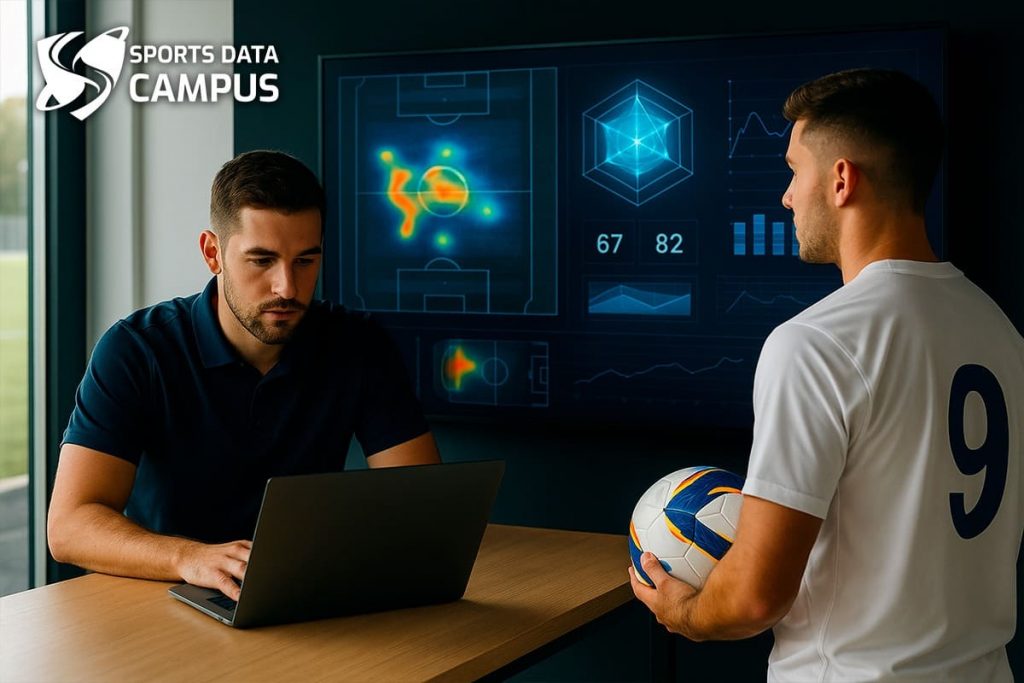
- Heatmaps and positional matrices, meanwhile, visually display how players occupy the pitch. These tools are essential for assessing the team’s tactical coherence, positioning during transitions, and effectiveness in ball recovery.
With these data, analysts build models that contextualise what happens on the pitch and create predictive scenarios. Which player would best fit a certain system? Which areas should be exploited against a specific opponent? How does a substitution affect tactical balance? Advanced analytics in football answers all these questions, providing solid arguments to support technical decisions.
How data become tactical decisions
Data alone do not win matches. The analyst’s job goes far beyond presenting figures — they interpret, filter, and contextualise information so that it becomes practical and applicable for the coaching staff.
The process begins with the analysis of both the team’s own playing model and that of the opponent. Patterns, recurring behaviours, and key moments in the match where tactical decisions have the greatest impact are identified. From there, data help validate or rethink specific strategies. For example, if a team struggles with balls played behind the defence, the model might suggest adjusting the defensive line or strengthening midfield control.
This process also applies to scouting, both for identifying talent and studying opponents. Through advanced analytics in football, specific player profiles are created to meet the team’s needs — players who press higher up the pitch, create advantages in one-on-one duels, or improve ball circulation during possession phases.
Another key use is performance prediction. By building statistical models, analysts can anticipate scenarios based on a player’s behaviour in different contexts. This becomes vital when planning transfers, managing rotation, or controlling workloads during weeks with multiple matches.
The impact of advanced analytics on performance
The key lies in transforming information into concrete actions. By thoroughly analysing physical, technical, and tactical metrics, the coaching staff can quickly identify what works and what needs adjustment. This enables faster and more efficient decision-making, improving preparation and final performance on the pitch.
Through technologies such as GPS, eventing systems, or platforms like Mediacoach, teams can visualise how their players perform under different conditions. These data reveal patterns of fatigue, positional efficiency, and influence across various phases of play. This makes it possible to design personalised routines that boost performance without compromising player health.
The impact is also evident at a collective level. Thanks to advanced analytics in football, coaches can align individual capabilities with the team’s overall style of play. This technical and tactical cohesion not only increases competitiveness but also strengthens the team’s identity.
Ultimately, when used effectively, data do not merely explain what happens — they anticipate what could happen and provide concrete solutions for progress. That is why more and more teams are making advanced analytics in football a fundamental pillar of their sporting model.
How advanced analytics improves tactical and physical preparation
On the tactical side, coaches analyse the team’s behaviour across different phases of play. Using tracking tools and analysis software, they detect positional imbalances, pressing errors, or a lack of synchronisation during transitions. From there, sessions are designed to correct those weaknesses, based on what truly happens during matches.
From a physical standpoint, data provide a clear competitive advantage. With GPS devices, accelerometers, and load sensors, the coaching staff can accurately measure intensity, accumulated fatigue, and each player’s maximum effort levels. This allows them to manage workloads, prevent injuries, and design recovery plans tailored to each individual profile.
Moreover, advanced analytics in football makes it possible to simulate real match scenarios during training. For example, if a team tends to lose intensity in the last 15 minutes, exercises are adjusted to specifically target that phase. Or if weaknesses are detected in set pieces, tailored drills are created to correct them.
In short, the data-driven approach turns training into a far more effective tool. Every decision is adapted to the team’s and player’s context, leading to better results, lower physical risk, and greater control of performance throughout the season.
What it contributes to collective and individual performance
Advanced analytics in football not only transforms how teams train or compete but also redefines how performance itself is understood. It is no longer enough to simply observe what happens on the pitch — data now make it possible to accurately detect how each player performs and how they contribute to the team’s overall functioning.
- At an individual level, analytics help visualise strengths and weaknesses that might otherwise go unnoticed. For example, a midfielder who seems uninvolved could have an exceptionally high rate of successful line-breaking passes, while a defender who loses many aerial duels might excel in positioning during moments of numerical inferiority. These insights allow coaches to adjust training, redefine roles, and optimise each player’s profile within the tactical system.
- On a collective scale, data provide a clear view of how players interact with one another and how the team responds under different conditions. This helps strengthen on-pitch connections, consolidate playing structures, and identify which pieces fit best according to the desired style. It also enables teams to compare their performance against various opponents or under different tactical setups.
Moreover, the consistent use of advanced analytics in football allows clubs to establish their own metrics aligned with their playing identity. In this way, an analytical culture is created that goes beyond daily operations and makes it possible to measure the true evolution of the sporting project.
The future of advanced analytics in football
The growth of advanced analytics in football shows no signs of slowing down. On the contrary, the coming years will mark a stage of maturity and sophistication in how data are generated, processed, and applied within the beautiful game. Analytics will become as essential a pillar as physical preparation or tactical planning.
One of the clearest trends is the full integration of analysis departments within the coaching staff. They are no longer seen as auxiliary areas but as engines of strategic decision-making. The most forward-thinking clubs are building their teams around hybrid profiles capable of combining data science with tactical understanding of the game.
In addition, new developments in sensor technology will allow data to be collected faster, more accurately, and in greater volume. The use of live Artificial Intelligence cameras, smart balls, and connected kits will take data collection to a more immersive level. This will enable coaches and players to access processed information almost in real time during matches.
Personalisation will also increase. Each player will have their own analytical performance model, with unique indicators based on their role, playing style, and objectives. This will make sports management more human and more efficient, finely tuned to each individual’s characteristics.
In management offices, analytics will be crucial for assessing transfers, projecting careers, reducing financial risks, and building sustainable teams. And in the stands, fans will gain access to new ways of experiencing football — more visual, more educational, and enriched with data that enhance their understanding of the game.
Artificial Intelligence, automation, and personalisation
The incorporation of Artificial Intelligence into advanced analytics in football is no longer a future possibility — it is an expanding reality. AI makes it possible to process data volumes unimaginable just a few years ago, detect patterns invisible to the human eye, and deliver more accurate insights in less time and with greater reliability.
AI is already being used, for instance, to automatically generate video clips based on detected events — key passes, recoveries, defensive actions, or finishes — significantly reducing the time analysts spend on repetitive tasks. It can also model tactical scenarios, simulating how a team might behave in different match situations. This enables the preparation of training sessions that are much more specific and tailored to each opponent.
Another major step forward is the automation of physical analysis. Platforms such as Catapult or STATSports not only collect data using GPS sensors but also automatically process alerts for overload, injury risk, or recovery needs. This allows workloads to be adjusted with surgical precision, aligning performance with player health.
At the same time, personalisation is advancing rapidly. By combining historical databases with machine learning models, each player can have a predictive profile that anticipates their development, identifies areas for improvement, and suggests the tactical environment most conducive to their performance.
Driven by AI, advanced analytics in football will become increasingly autonomous, predictive, and tailored to the specific needs of each club and professional. It is not just about seeing more — it is about seeing better, and turning data into intelligent decisions that truly make a difference on the pitch.
The future of football will be smarter, more connected, and more demanding — and advanced analytics in football will be at the very heart of this evolution
Specialised training for the new generation of professionals
The revolution of advanced analytics in football would not be possible without a new generation of professionals equipped to face emerging challenges. Today, understanding football is not enough. It is essential to master technological tools, understand how statistical models work, and be able to turn data into concrete on-pitch actions.
Clubs are now looking for hybrid profiles — people who understand the logic of the game but can also use visualisation software, tracking platforms, automated tactical analysis systems, advanced metrics, or predictive models. The ability to present data in a clear, actionable way for the coaching staff and adapt it to specific contexts is particularly valued.
This is where training becomes decisive. Programmes such as the MSc Data Analytics in Football are designed precisely to develop these new profiles. This master’s degree combines tactical and statistical knowledge with hands-on use of professional tools such as WyScout, Hudl, Mediacoach, and Tableau, preparing students to work in high-performance environments from day one.
Moreover, its practical approach — featuring real case studies from professional clubs and classes delivered by industry experts — allows students to understand how theory is applied in the daily reality of modern football. It also opens the door to a global network of contacts, collaborations with clubs, and job opportunities within the sector.
Want to be one of them? Fill in the form below to receive more information about the MSC Data Analytics in Football
