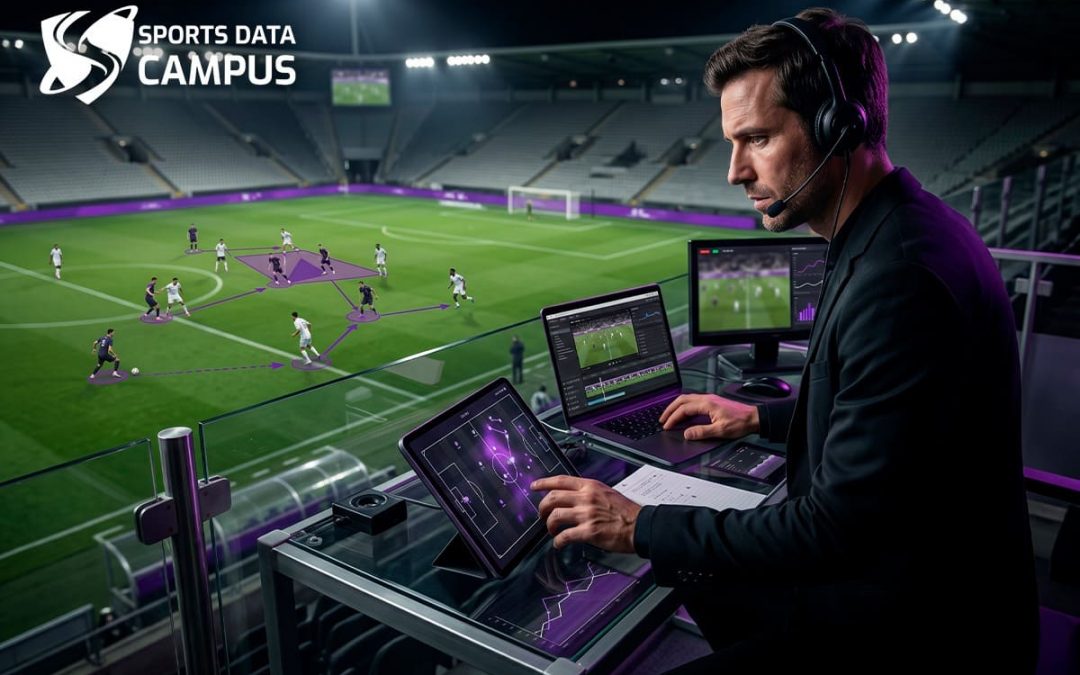
The tactical analysis is an operational pillar within professional coaching staffs that structures decision-making in training, competition and weekly planning.
The growth of data volume, improvements in video and the integration of advanced technology are redefining this role. Today, tactical analysis connects objective information, competitive context and effective communication with staff and players.
In this article, you will see how to carry out effective tactical analysis, what the real responsibilities of the analyst are, which technologies make it possible and how professional clubs integrate it into their performance model. All from a practical perspective, aligned with the evolution of modern football and the smart use of Big Data and Artificial Intelligence in sport.
How to carry out tactical analysis
For tactical analysis to be effective, it must rely on a structured process that starts with a clear objective and ends with direct application on the pitch. The analyst selects relevant information, interprets collective behaviours and extracts patterns that explain how and why specific game situations occur.
The key does not lie in accumulating data, but in linking it to the competitive context, the playing model and the decisions the coaching staff need to make. This approach turns analysis into an operational tool that connects observation, interpretation and action within the team’s daily dynamics.
Tactical analysis transforms contextualised information into operational decisions by identifying collective patterns aligned with the playing model
5 responsibilities you must fulfil to become a top tactical analyst
The analyst’s role goes far beyond watching matches or tagging actions, as it connects information, context and communication to improve collective performance and support decision-making within the club. Each responsibility responds to a specific need of the coaching staff and requires rigour, judgement and the ability to synthesise information.
Fulfilling these tasks in a structured way turns tactical analysis into a real tool that supports the game, rather than an isolated theoretical exercise.
Capture and structure key information from the game
Capturing information in tactical analysis means building a solid base of data and observations that explain what is really happening in the game. The analyst identifies which phases, behaviours and spatial relationships are relevant according to the playing model and the competitive context. This work combines video analysis, structured observation and data review to detect collective patterns, opponent adjustments and the team’s own responses.
Information is not collected indiscriminately, as it is filtered based on the objective of the analysis and the type of decision that will be made later. This requires prioritising quality over quantity and maintaining consistency in observation criteria. When information is properly captured, tactical analysis becomes a tool that explains behaviours and anticipates scenarios.
Produce clear and useful reports for decision-making
Producing reports in tactical analysis means turning complex information into knowledge that the coaching staff can actually use. The analyst synthesises data, video sequences and observations into clear messages that support decision-making. The aim is not to show everything analysed, but to highlight what truly matters to prepare training sessions, adjust tactical plans or intervene during competition.
The structure of the report adapts to the audience, as a coach does not require the same level of detail as a player. The analyst adjusts the language, visual support and depth of content to ensure immediate understanding. When a report is well designed, it reduces uncertainty, aligns the working group and turns tactical analysis into an operational tool with a direct impact on team performance.
Detect hidden patterns and explain them to the coaching staff and players
One of the most valuable roles in tactical analysis is to reveal behaviours that are not obvious at first glance. The analyst identifies repeated patterns, structural imbalances and spatial relationships that influence the game but often go unnoticed in real time. This deeper reading makes it possible to explain why certain situations occur, not just describe what is happening.
The key lies in translating these findings into clear messages for both the coaching staff and the players, linking data and video to explain behaviours without creating ambiguity. When hidden aspects of the game become visible and are properly contextualised, the team gains coherence, improves decision-making and adjusts its collective behaviour with greater precision.
Optimise the coach’s working time
Tactical analysis also plays a key operational role by optimising the coach’s time, as the analyst takes on observation, filtering and synthesis tasks. This allows the coaching staff to focus on planning, squad management and strategic decision-making. This division of responsibilities improves team efficiency and reduces cognitive load throughout the week.
By anticipating scenarios, organising information and presenting clear conclusions, the analyst streamlines processes that would otherwise take hours of review and discussion. The coach receives structured, contextualised information ready to be applied. When tactical analysis frees up time, the team gains focus, clarity and a greater capacity to act, leading to more precise sessions and better-informed decisions.
Support the technical department in scouting and planning
Tactical analysis provides direct value to the technical department by offering an objective reading of player profiles, behaviours and how they fit within a specific playing model. The analyst contributes to player evaluation through tactical patterns, decision-making and adaptation to different competitive contexts, going beyond isolated performance.
This information reduces risk in scouting and planning processes, as the technical department receives reports that contextualise performance, identify functional roles and anticipate the real impact of a signing on the team. In this way, tactical analysis connects what happens on the pitch with the club’s strategy, aligning sporting decisions with a coherent and sustainable vision.

Recommended software and technologies for tactical analysis
Today, tactical analysis relies on a technological ecosystem that allows work to be carried out with greater depth, speed and precision. Video remains the central element, but its value increases when it is integrated with structured data and visualisation tools that support collective interpretation of the game.
- Video analysis platforms make it possible to segment actions, identify recurring behaviours and link sequences to specific phases of play. This work is strengthened by databases that store events and tactical metrics, enabling comparisons, performance tracking over time and analysis across different competitive contexts.
- Visualisation tools transform this information into spatial maps, time-based sequences and clear representations of collective behaviour. In this way, the analyst identifies relationships between players, space occupation and dynamics that do not emerge through traditional match review.
- The integration of Big Data and models based on Artificial Intelligence expands the scope of tactical analysis. These technologies help identify hidden patterns, simulate scenarios and prioritise relevant information according to the needs of the coaching staff. The real value does not lie in the tool itself, but in how it is integrated into the daily workflow.
When technology is used with clear intent, tactical analysis gains coherence, consistency and a real impact on team performance.
The analyst’s role is not limited to watching and analysing matches, as it also involves additional responsibilities that ensure the proper functioning of both the team and the club
Success stories in professional clubs
Tactical analysis has become a key differentiating factor in clubs that have successfully integrated it into their sporting structure. Teams such as Sevilla FC have adopted analysis as a transversal tool that connects coaching staff, scouting and competitive planning, improving the coherence between the playing model and decision-making.
Other European clubs have moved in the same direction by professionalising the analyst’s role and providing it with technological resources and operational autonomy. The systematic use of video, the contextualisation of data and clear communication with coaches and players allow for more precise tactical adjustments, better match preparation and faster adaptation processes for new signings.
These examples show that success does not depend solely on having advanced technology. The key lies in having professionals capable of interpreting information, integrating it into the team’s daily routine and turning tactical analysis into a real competitive advantage. This professional and applied approach is developed in programmes such as the MSc Data Analytics in Football, where tactical analysis is addressed from a practical perspective, closely aligned with the reality of professional clubs and the current demands of modern football.
Want to be one of them? Fill in the form below to receive more information about the MSC Data Analytics in Football