

A football analyst works with information from video, data, scouting and physical performance to understand what happens both on and off the pitch. Depending on the area they work in, they may analyse players, team behaviour, training loads, statistical models or decisions linked to sporting planning.
There are several different roles within football analysis. A scout observes and compares players; a video analyst studies technical and tactical behaviour; and a data analyst turns football-related questions into analysis using statistics, programming and data visualisation. Other areas include physical performance analysis, sporting management and player development and monitoring within academy football.
Therefore, working as a football analyst requires a combination of football knowledge and specific technical skills depending on the area of specialisation. In the following sections, we look at what each role involves and how important its main skills are, using the Football Skills Map as a reference, where you can compare each area visually.How to Start Working as a Football Analyst
To start working as a football analyst, you need to develop three foundations from the outset: understand the game, learn how to structure an analysis and identify which technical skills you still need to develop. You do not need to begin with complex projects; what matters is building a way of working that you can repeat, justify and showcase. From there, these three steps will help you build your first practical foundation:
- Learn to observe the game with a specific question in mind: Watching lots of matches is not the same as analysing them. Study what each team does in and out of possession, how they organise their press, which spaces they occupy, how they progress the ball, what changes between phases and which decisions the coach makes. This process develops a more structured understanding of the game and prevents your analysis from focusing only on isolated actions.
- Build your first analysis and document it: Choose a match and define a specific question, such as how a team progresses from the first line against a high press. Then use video, public data or both to gather evidence and prepare a short report. A well-supported one-page analysis, accompanied by relevant graphics or video sequences, is already enough to serve as your first work sample.
- Identify the skills you need to strengthen: Assess your level in tactical analysis, data, video, statistics, programming, tools or methodology depending on the area you want to develop. Specialised training makes sense when it addresses a specific skills gap and allows you to work with processes, technology and cases that are closer to the professional football environment.
If you want to progress as a football analyst, explore the Football Skills Map and see which areas you should develop further
How to Work as a Football Analyst
The role of a football analyst varies depending on the area they work in. Scouting, video analysis, data analysis, performance, sports management and innovation, and academy football each require a different combination of game knowledge, tools and technical judgement, although they all share the same objective: interpreting relevant information to support decision-making within a sporting organisation.
Scouting and Talent Assessment
Scouting in professional football is based on structured player observation rather than isolated impressions. A scout analyses behaviour in and out of possession, decision-making, use of space, responses to different competitive contexts and adaptation to the demands of a position. Based on this evidence, they compare profiles and build an assessment to support recruitment decisions.
Game observation and the assessment of players and their potential carry the greatest weight in this work. Both require the scout to interpret current performance while distinguishing it from a player’s potential for development. A player may stand out statistically yet still fail to meet the tactical, physical or competitive demands of a particular playing model.
For this reason, the scout must also assess how well a player fits the team’s playing model. A player’s nominal position says little on its own. What matters are the functions they perform, the spaces they occupy, the decisions they make and how they respond to different structures. In addition, video and data help validate observations, increase sample sizes and compare players using consistent criteria.
The process is complete when the evidence is turned into clear reports and recommendations for sporting directors and coaching staff. A good report does not simply collect actions or statistics without any hierarchy. It connects what has been observed with the team’s sporting needs, explains strengths and limitations, and provides a clear record of the criteria used.
For a football analyst specialising in scouting, technology adds speed and depth, but the real value still lies in observing, contextualising, comparing and supporting a football assessment with evidence.
Video Analyst and Technical-Tactical Analysis
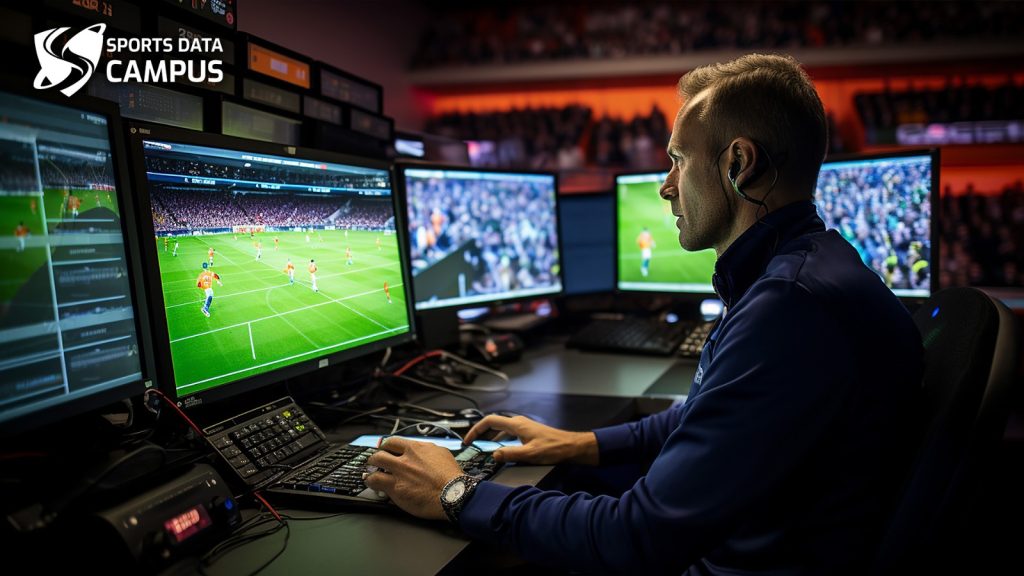
A football video analyst studies the behaviour of their own team and the opposition through match footage to identify patterns, relationships between players and responses to specific situations during a match. Their role goes far beyond simply cutting and organising clips. Technical and tactical understanding determines which actions are worth analysing, how they are classified and what information ultimately reaches the coaching staff or players.
Analysing their own team allows the video analyst to review attacking and defensive structures, pressing, transitions, use of space, ball progression and recurring behaviours. In contrast, opposition analysis focuses on identifying build-up patterns, progression methods, chance-creation mechanisms, defensive organisation and potential vulnerabilities that can help prepare for the next match. In both cases, an isolated sequence offers little value unless it is interpreted within the context of the match and compared with similar actions.
Video capture and coding provide structure to this process. The video analyst tags events, phases of play and previously defined behaviours to locate sequences quickly and build representative samples. Editing and presentation then reduce large volumes of footage into specific clips that answer a particular tactical question.
Communication is therefore also part of the analysis. A video analyst needs to turn hours of match footage into concise, contextualised information that the coaching staff can use effectively. The format, timing and audience determine how much detail each presentation should include.
Within the work of a football analyst, video analysis connects tactical knowledge, technology and communication. The tools make it easier to record and retrieve actions, but the technical value depends on knowing what to look for, understanding why it happens and selecting the evidence that best explains individual or collective behaviour.
Sports Data Analyst
A sports data analyst turns football-related questions into structured analysis using reliable data. Their work begins before writing code or building a model. First, they need to understand which football problem they are trying to solve, what information is available and how reliable the data is, because a poorly defined starting point affects everything that follows.
Data collection and data quality carry the greatest weight in this role. The analyst works with different sources, checks formats, identifies missing values, detects inconsistencies and verifies that each variable correctly represents the action or context it is intended to measure. Only then does the statistical and computational work begin.
Programming helps automate processes, clean information, combine datasets and build reproducible analyses. Languages such as Python or R make it possible to work with large volumes of information, while SQL is essential when data is stored in structured databases. However, code does not replace football knowledge or a well-defined question.
Statistics and modelling help describe patterns, compare players or teams and estimate relationships between variables. Data visualisation, meanwhile, turns complex results into charts, dashboards or reports that make trends easier to interpret without losing the football context.
Finally, communicating results connects analysis with decision-making. A good analyst does not simply deliver metrics or models. They explain what each result means, what its limitations are and how it relates to the original football question, adapting the level of technical detail to the coaching staff, sporting directors or department receiving the information.
For a football analyst, working with data means combining football context, data quality, statistics, programming and communication within the same analytical workflow.
Physical Preparation and Performance Analysis
Physical preparation in football combines training planning, load management, performance assessment and coordination with other members of the coaching and medical staff. The goal is not simply to improve a player’s physical condition, but to adapt training to the real demands of competition and to each player’s individual response.
Training planning organises content, intensity and recovery across microcycles, competitive weeks and longer periods. From there, strength and conditioning develop physical qualities linked to performance, while monitoring helps assess how each player responds to the work carried out.
Load management combines external information, such as distance covered, accelerations, sprints or high-intensity efforts, with internal variables linked to physiological response. Interpreting both dimensions helps adjust training volume and intensity, identify accumulated fatigue and coordinate recovery and match availability more effectively.
Physical assessment and monitoring also make it possible to compare progress, identify changes in performance and put a player’s response to different tasks into context. When an injury occurs or availability is reduced, return-to-play work uses progressive criteria to support a gradual return to training and competition.
For this reason, this area requires constant multidisciplinary coordination between strength and conditioning, return-to-play staff, medical staff, physiotherapists and the coaching team. The value of analysis lies not only in collecting data, but in using it to adjust training decisions through a shared view of performance.
Sports Management and Innovation
Sports management and innovation focuses on driving projects, technology and new ways of working to transform a sports organisation. This area combines strategic vision, business knowledge and the ability to coordinate digital initiatives that affect different parts of the organisation.
Digital project management carries the greatest weight within this profile. It involves defining objectives, coordinating teams, setting priorities and overseeing the delivery of initiatives linked to technology, data, automation or digital experience. Strategy and innovation are equally important, helping identify opportunities and turn them into projects with a real impact within the club or organisation.
Data-driven decision-making helps assess processes, measure results and reduce reliance on purely intuitive judgement. At the same time, fan experience is becoming increasingly important, as many digital initiatives aim to improve the relationship between the organisation, its supporters and the different points of contact between them.
Partnerships and business development also play an important role, especially when projects require collaboration with technology companies, sponsors or new strategic partners. All of this requires leadership and change management, because introducing new tools or processes depends not only on technology, but also on the ability to help different areas adopt new ways of working.
Mastering the right tools allows analysts to turn data into actionable insights. It is not just about collecting statistics, but about interpreting and presenting them effectively to support decision-making
Player Analysis and Development in Academy Football
Academy analysis focuses on tracking a player’s development as part of a long-term learning process, rather than looking only at immediate performance. The analyst needs to understand how the player’s behaviour changes over time, which areas become more established, which difficulties remain and how they respond to new tactical, physical and competitive demands.
Understanding the game plays a central role because it helps explain the player’s decisions within each context. In academy football, recording isolated actions is not enough. They need to be linked to the player’s position, the phase of the match, the team structure and the stage of development the player is going through.
Tracking individual development requires comparing information over weeks and months. Video and data help identify patterns, changes and trends, while performance assessment provides reference points for evaluating whether the player is progressing in the areas defined by the coaching staff.
Feedback also needs to be adapted carefully. The information should match the player’s age, level of understanding and stage of development, avoiding an overload of metrics or explanations that do not support learning. For this reason, academy analysis has an educational dimension that is not as prominent in other areas of professional football.
The process also depends on constant coordination with coaches and methodology staff, as analysis becomes meaningful when it is integrated into shared development objectives rather than used as an isolated assessment of the player.
Working as a football analyst means choosing which areas of knowledge you want to develop in greater depth and understanding which skills carry the most weight in each role. Scouting, video analysis, data, performance, sports management and academy football all respond to different needs within a professional sporting structure.
If you want to compare these differences visually and better understand where your current profile fits, complete the form and access the Football Skills Map. There, you can review each area, its main skills and the relative importance of each one before deciding on your next step in training.

Original version https://sportsdatacampus.com/quiero-trabajar-como-analista-de-futbol/