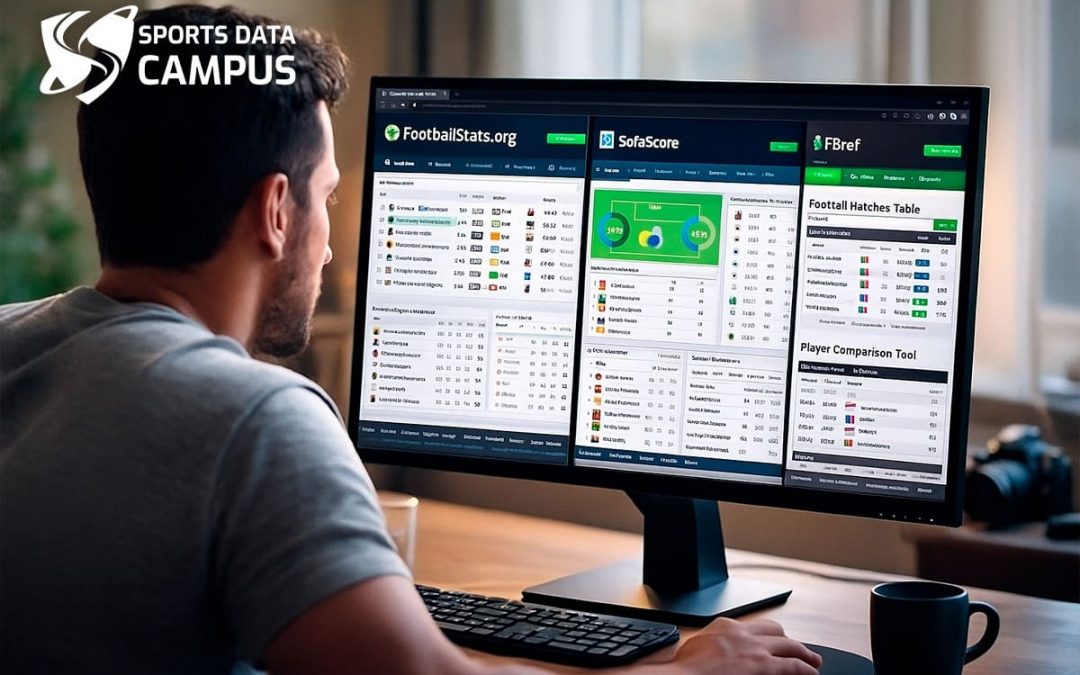
That’s why new platforms appear every day, allowing users to download statistics, explore advanced metrics and follow competitions from anywhere. These tools are changing the way people work and learn, providing a solid base to experiment with Power BI, Python or Excel. In this article, you’ll discover which ones are the most useful and how to make the most of them to build a more complete analytical view of modern football.
Discover the best free football data websites
Free football data websites have become a meeting point for analysts, coaches and fans who want to understand the game from a more technical perspective. These platforms collect information from domestic and international leagues and present it in a structured way, making it easier to use in analysis projects or professional reports. They provide data on performance, positioning, possession, expected goals and physical development, helping users spot patterns and make well-grounded decisions.
The real value of football data websites lies not only in the volume of information they offer, but also in the accuracy of their updates and the ability to combine different variables. Some platforms allow data to be downloaded in formats compatible with Power BI or Python, while others include interactive visualisations that simplify trend analysis. Thanks to these open sources, football analysis is now more accessible, more rigorous and far more collaborative.
| Platform | Best for | Level | Main data | Access |
|---|---|---|---|---|
| FBref | Scouting and performance analysis | 🟢 Beginner | Statistics, xG, players and teams | Free ✅ |
| Sofascore | Match tracking | 🟢 Beginner | Results, heat maps and player ratings | Free ✅ |
| FotMob | Live statistics | 🟢 Beginner | Results, xG and basic metrics | Free ✅ |
| FootyStats.org | League statistics | 🟢 Beginner | Results, trends and historical statistics | Free ✅ |
| Futbolme.com | Spanish football | 🟢 Beginner | League tables, fixtures and results | Free ✅ |
| Understat | Advanced statistics | 🟡 Intermediate | xG, xA and advanced models | Free ✅ |
| StatsBomb Open Data | Python and data analysis | 🔴 Advanced | Complete match event data | Free ✅ |
| Football-Data.co.uk | Predictive models | 🟡 Intermediate | Historical results and betting odds | Free ✅ |
| API-Football | Automation | 🔴 Advanced | Results and statistics API | Freemium ⚠️ |
| 5DollarFootballAPI | APIs and data projects | 🔴 Advanced | Fixtures, live scores, standings, statistics and odds | Freemium ⚠️ |
| PlayeRank (Wyscout) | Professional scouting | 🟡 Intermediate | Player rankings and performance evaluation | Free ✅ |
| WhoScored | Individual performance | 🟢 Beginner | Statistics and player ratings | Free ✅ |
| Transfermarkt | Transfer market | 🟢 Beginner | Market values, contracts and squads | Free ✅ |
| Opta Analyst | Reports and analysis | 🟡 Intermediate | Articles and advanced metrics | Free ✅ |
Tip: No single platform provides everything a football analyst needs. In practice, analysts combine multiple sources depending on the type of analysis, the level of detail required and the tools they use.
Football is no longer explained by intuition alone. Open data is democratising analysis and shaping a new generation of professionals who can turn information into real, useful knowledge
Free resources for football data analysts
Today’s ecosystem offers a wide range of free resources for football data analysts. These tools provide access to reliable information without the need for expensive licences and represent the first step towards building professional skills in sports analytics. They make it possible to explore advanced metrics, historical statistics, heat maps and open databases, covering everything from major European leagues to local competitions.
Their value goes beyond simple performance observation, as they also support the creation of predictive models and visual dashboards to interpret the dynamics of the game. Analysts use these websites to produce tactical reports, identify team trends or compare players across different competitive contexts. Learning how to use them with proper judgement turns each professional into a more complete profile, capable of transforming data into applied knowledge for real football scenarios.
FBref
FBref is one of the most recognised platforms in football data analysis. Created by Sports Reference, the company behind some of the most respected sports databases in the United States, it offers detailed statistics for thousands of players, teams and competitions. Its main strength lies in the breadth of information available, ranging from traditional metrics such as goals and assists to advanced indicators like expected goals (xG), expected assists (xA), successful pressures and defensive actions. The data is sourced from Opta, which ensures consistency and accuracy across all covered leagues.
The site’s structure makes it easy to access the most relevant sections, with dedicated areas for individual performance, historical comparisons and season-by-season analysis. It also allows users to explore variables by team or player, filtering by minutes played, pitch zones or tactical role. The “Stats by Position” section is particularly useful for spotting specific patterns among midfielders, defenders or forwards.
FBref is an essential resource for analysts looking for reliability and context, as reports are updated daily, making it possible to track recent trends without relying on paid tools. It works especially well for those using Power BI or Python, since the data can be easily exported to spreadsheets. Thanks to its balance between depth and accessibility, FBref has become a reference tool both for professionals working on advanced scouting and for students taking their first steps in football performance analysis.
Sofascore
Sofascore is one of the most complete platforms for following and analysing football matches in real time. Launched in 2010, it has become a global reference thanks to its ability to combine fast data updates with clear and engaging visualisation. Its coverage includes more than 500 competitions, spanning domestic leagues, continental tournaments and international fixtures, which ensures constant and reliable access to match information.
The real strength of Sofascore lies in its visual approach. Each match features a detailed statistics panel with indicators such as possession, shots, duels won, pass accuracy and defensive actions, all supported by dynamic charts that help explain how the game unfolds. It also provides heat maps and zones of influence for both teams and players, making it easier to identify tactical behaviours or structural imbalances. These visual tools are widely used by analysts and sports journalists to produce technical summaries or quick reports.
Sofascore also includes its own player rating system, known as the SofaScore Rating, which assigns a score based on a player’s overall impact during the match. This algorithm, built on advanced statistics, is highly regarded for how closely it matches real on-pitch performance. Its mobile app, available across all platforms, offers live data and alerts, making it a practical tool for scouting, match preparation or individual performance tracking.
Thanks to its balance between immediacy, depth and visual design, Sofascore has become an essential ally for analysts who want to combine observation, metrics and tactical context within a single platform.
FotMob
FotMob is one of the most widely used platforms among professionals and fans who follow football from an analytical perspective. Developed in Norway in 2004, it has evolved from a simple live scores app into a complete sports data ecosystem. Today it delivers detailed statistics, live commentary and visual analysis for more than a thousand competitions worldwide, with constant updates that ensure accuracy and relevance.
What sets FotMob apart is its balance between precision and presentation, as each match includes metrics on possession, shots, chances created, expected goals, duels won and passing efficiency. These statistics are displayed alongside clean, easy-to-read graphics that help interpret the tempo of the game and individual player performance. Its database is fed by official data providers, which guarantees consistency with league and federation records.
The platform also includes personalised tracking features that allow analysts to receive alerts about specific teams or players, making it especially useful for scouting reports or performance monitoring. In recent years, FotMob has added more advanced metrics, such as shot maps and goal probability values, offering a more tactical perspective. Its mobile app, available in multiple languages, provides instant access to live statistics and has become an essential tool for analysts who need reliable information during matches.
FotMob represents a strong balance between real-time information and structured analysis. It is a modern, reliable and flexible platform that suits different experience levels, enabling users to follow global competitions with a level of detail that was once only available to professional clubs.
FootyStats.org
FootyStats.org is a platform focused on advanced statistical analysis of modern football. Its approach stands out for offering performance metrics and predictive insights built on large volumes of data from competitions around the world. The database covers more than 1,000 leagues, ranging from major European competitions to regional tournaments, making it one of the most extensive and up-to-date free sources for analytical work.
The main value of FootyStats.org lies in its probabilistic focus, as it goes beyond traditional statistics to calculate projections such as win probability, average goals per match or the frequency of both teams scoring. It also includes indicators like home and away performance, goals scored by time intervals and current winning or losing streaks. This mix of historical data and predictive modelling allows analysts to identify behavioural patterns and tactical trends with a high level of detail.
The interface is intuitive and well organised, with dedicated sections for leagues, teams and players. Each profile includes performance charts and tables showing how results evolve throughout the season. In addition, part of the data can be exported for use in spreadsheets or visualisation tools. Although it does not offer an open API, its accuracy and daily updates have made it a trusted reference among independent analysts and content creators.
FootyStats.org is ideal for those looking for a versatile tool that combines descriptive statistics with well-grounded projections. Its probability-driven approach makes it a valuable resource for spotting game dynamics and assessing team performance through a structured and predictive lens.
Futbolme.com
Futbolme.com is one of the longest-running and most comprehensive football information websites in Spain. Launched in 2002 as an independent project focused on collecting results and league tables from domestic competitions, it has grown into a reference tool for journalists and analysts alike. Its main strength lies in the depth of its coverage, as it provides up-to-date data across all levels of Spanish football, from LaLiga to regional divisions and grassroots competitions.
The site’s structure makes it easy to navigate by season, matchday or team, allowing users to track the historical evolution of each club. Every team profile includes results, line-ups, basic statistics and competition comparisons. Futbolme also stands out for its reliability and near real-time updates, offering a level of detail that few national platforms can match. For analysts working in youth football or local scouting, this database is particularly valuable, as it helps trace development paths, spot emerging talent and analyse collective performance.
Another key asset is its historical archive, which preserves data from past seasons and supports long-term analysis. The platform also links to official match reports and federation records, something rarely found on open websites. Although it does not provide advanced metrics or interactive visualisations, its consistency and accuracy make it a solid reference point for contextualising data or validating information from other tools.
Thanks to its reliability, broad scope and strong focus on Spanish football, Futbolme.com remains an essential resource for anyone needing accurate information on teams, youth categories or semi-professional competitions, while maintaining a clear commitment to open data and continuous updates.

StatsBomb Open Data
StatsBomb Open Data is the open data initiative created by the British company StatsBomb, one of the most respected providers of football metrics worldwide. Launched in 2018 with a clear goal, it makes part of its professional database publicly available to support research, education and the development of performance analysis. Since then, it has become an essential resource for analysts, data scientists and students who want to work with real, well-structured football data.
Its main strength lies in the quality and granularity of the datasets. Every match event, including passes, shots, pressures, duels and interceptions, is precisely geolocated on the pitch and enriched with contextual variables such as the foot used, body orientation or opponent positioning. This level of detail goes far beyond most open data sources currently available. The datasets are published in JSON format and can be freely downloaded from the official GitHub repository, making them easy to integrate into analytical workflows using Python, R or Power BI.
StatsBomb Open Data is regularly updated with new seasons from domestic leagues and international tournaments, covering men’s, women’s and youth competitions. On top of that, the user community has created additional tools, visualisations and tutorials that significantly enhance its educational value. These datasets are widely used in universities, specialist courses and research projects focused on tactics and performance.
Thanks to its depth, reliability and clear educational focus, StatsBomb Open Data is an ideal starting point for any analyst looking to work with elite-level football data without the need for commercial licences. It offers direct access to professional analysis, with the added benefit of being open to everyone.
API-Football
API-Football is one of the most complete and up-to-date sources for accessing football data through a direct API connection. It is part of the RapidAPI ecosystem, a platform that brings together programming interfaces and allows applications, dashboards or scripts to connect with real-time sports databases. Its free tier offers a limited number of daily requests, which is more than enough to learn how to automate workflows and develop personal analysis projects.
Unlike websites that simply display statistics on screen, API-Football delivers structured data in JSON format, ready to be integrated into tools such as Python, R or Power BI. This makes it easier to build automated pipelines, keep charts updated in real time or feed predictive models. The available data includes results, line-ups, match events, league tables, players, transfers and detailed statistics by team or competition. Coverage exceeds 1,200 leagues and tournaments, with frequent updates and support for multiple languages.
The RapidAPI dashboard provides access to clear technical documentation and allows users to test each endpoint directly from the browser, which greatly simplifies the learning curve. Analysts and developers use it to build interactive dashboards or design algorithms that process live data. Its accuracy and clean structure make it an ideal tool for those looking for a more technical approach to football analysis, focused on data collection and processing.
API-Football acts as a bridge between open access and professional automation. It allows data to flow dynamically into dashboards, reports and predictive models, a key step for any analyst aiming to master advanced data management in modern football.
5DollarFootballAPI
5DollarFootballAPI is a football data API designed for analysts, developers and students who want to work with structured football data without relying on manual data collection. Unlike statistics websites built mainly for browsing, it returns information in JSON format, making it particularly useful for projects developed with Python, dashboards or automated analysis workflows.
Its free plan provides access to the five major European leagues — the Premier League, LaLiga, Serie A, Bundesliga and Ligue 1 — and includes fixtures, live scores, league tables and betting odds. Users can make up to 60 requests per hour and access the last three months of results without providing a credit card.
The API also supports match statistics and offers official Python and Node.js clients, which makes it suitable for users who want to move beyond simply viewing football statistics and start working directly with structured data. More extensive competition coverage, higher request limits and deeper historical data are available through its paid plans.
For aspiring football data analysts, 5DollarFootballAPI is particularly useful for learning how to connect an API to an analytical workflow and turn live or historical football data into models, dashboards and automated applications.
PlayeRank (Wyscout)
PlayeRank is a football performance evaluation system developed by Wyscout in collaboration with Sportradar and the research group from IMT School for Advanced Studies Lucca. It began as a scientific project with a clear aim: to build an objective, quantitative model for measuring player performance based on real event data. Its development was published in specialised academic journals, which guarantees methodological rigour and transparency.
Unlike subjective ratings or closed algorithms, PlayeRank combines action-based metrics, match context and playing position to calculate each player’s contribution to collective performance. It analyses thousands of events per match, including passes, duels, recoveries, shots and pressures, and weighs their impact according to the final result and the area of the pitch. This approach produces a comparative performance index that makes it possible to assess players from different leagues using consistent criteria.
Access to PlayeRank is partially open through technical reports and academic publications, while full integration is available within the Wyscout platform, widely used by professional clubs and scouting analysts. Even so, studies and datasets derived from its methodology can be consulted publicly on the project’s website or in academic repositories, where the mathematical foundations of the model are clearly explained.
For data analysts, PlayeRank stands as a benchmark in the application of Inteligencia Artificial and algorithmic models to sports performance. It represents the future of quantitative evaluation, using an evidence-based system that turns on-pitch actions into reproducible and comparable scores. Its philosophy brings together science, technology and tactics, strengthening the link between academic research and applied analysis in professional football.
Football analysis has entered a new era driven by data. Those who learn how to interpret it will be the ones leading the future of the game
Football-Data.co.uk
Football-Data.co.uk is a solid source for working with historical European football data and stands out for offering clear, well-organised information that is ready to use. All content is available in CSV format, which means files can be imported directly into Power BI, Python or Excel without complex data cleaning. This level of accessibility makes it especially valuable for analysts who need a reliable base to study trends or build performance models.
The platform collects data from leagues such as the Premier League, LaLiga, Serie A, the Bundesliga and Ligue 1, organising everything by season. Each dataset includes results, goals scored, goals conceded, home and away performance and recent runs of form. While it does not provide advanced metrics or event-level data, its simple structure allows analysts to spot collective patterns quickly and create long-term comparisons between teams. This stability also makes it easier to automate workflows without worrying about frequent format changes.
One of its key strengths is the consistency of its records, as Football-Data.co.uk maintains a uniform standard across seasons, something that is not always guaranteed with free data sources. This supports longitudinal analysis and provides a strong foundation for studying how team performance evolves over time. The site also includes data related to betting markets and odds, which can be useful for those researching predictive models or competitive patterns from a statistical angle.
Football-Data.co.uk is a practical tool for students, analysts and professionals who need structured and reliable historical data. Its value does not lie in advanced features, but in clarity and consistency. For anyone looking for a stable platform with analysis-ready football data, it remains a trusted reference within the football data ecosystem.
WhoScored
WhoScored is one of the most widely recognised platforms in football analysis, as it combines detailed statistics with its own data-driven player rating system. Its information comes from official data providers and covers the world’s major leagues, ensuring consistent and regularly updated records. The platform allows users to explore both team and individual performance metrics, along with heat maps, action zones and passing distributions that help explain tactical behaviour.
One of its most popular features is the WhoScored Rating, a model that evaluates players based on their overall impact during a match. This index is built from actions such as shots, duels won, recoveries and key passes, producing a score that is easy to interpret. While it does not replace in-depth tactical analysis, it offers a very useful starting point for comparing performances and spotting trends quickly.
WhoScored also stands out for its visual presentation. Player reports include season-by-season statistics, club history, performance in specific competitions and comparisons with other players in similar roles. For analysts studying patterns of play or preparing opposition reports, this information helps identify recurring behaviours and assess each player’s role within the team structure.
The platform also provides advanced breakdowns such as attacking contribution, defensive actions, passing efficiency and influence across different areas of the pitch. This breadth makes it a valuable resource both for those starting out in analysis and for professionals who need a quick and reliable overview of performance. With constant updates and a user-friendly design, WhoScored has firmly established itself as a reference tool in football data analysis.
Transfermarkt
Transfermarkt is one of the most consulted databases worldwide when it comes to information about players, clubs and transfer activity. Its main value lies in the breadth of its records, as it stores up-to-date data on thousands of footballers, competitions and seasons. The platform allows users to review matches played, minutes on the pitch, usual positions, injury history and a detailed overview of each player’s career path. It also includes information on signings, contract length and transfers, making it a very useful tool for both sporting and financial analysis.
One of Transfermarkt’s most recognisable features is the estimated market value assigned to each player. This figure does not represent an actual price, but reflects a trend based on performance, age, potential and contractual situation. For analysts studying squads or comparing player profiles, these values offer a clear reference point to understand a player’s development and competitive standing within the global market.
The platform also provides detailed club profiles, including squad statistics, performance by season, commonly used systems and visual summaries of transfer activity. This helps explain how a team is built and how its structure has evolved over time. For those preparing reports or analysing opponents, Transfermarkt makes it easier to identify patterns such as attacking dependency, squad depth or rotation across competitions.
Another key strength is its historical archive, which contains data from leagues and tournaments across multiple continents. This allows for broad comparative analysis or for tracking players who have competed in different championships. Thanks to its reliability, frequent updates and wide range of information, Transfermarkt remains an essential tool for analysts, sports journalists and fans who want to understand football from a structural perspective.
Understat
Understat is a highly regarded platform within advanced football analysis because it focuses on metrics built around expected goals and expected assists. These metrics make it possible to understand the real performance of teams and players beyond the final scoreline, offering an objective view of the quality of chances created or conceded. The platform works with its own models, developed through statistical analysis and event data, which provides a deeper reading of the game.
The website covers several top-level leagues, including the Premier League, LaLiga, the Bundesliga, Serie A and Ligue 1, and presents the data in a clear and accessible way. Each match includes shot maps, goal probability per action, cumulative xG values and team comparisons. For analysts looking to study attacking efficiency or defensive solidity, these tools help reveal patterns that are not visible by simply looking at results. It is also possible to explore time-based charts showing how goal probability evolves throughout a match.
Understat allows statistics to be filtered by season, matchday, position or individual player. Its database makes it easier to spot trends such as players who consistently generate high-quality chances, teams that finish above expected levels or defences that concede less than their results suggest. This approach adds valuable context for scouting work, tactical analysis and performance reporting.
The platform stands out for its balance between statistical rigour and visual simplicity, which makes it accessible even for those just starting with advanced analysis. Its models are updated regularly and remain aligned with the empirical evidence used by the analytical community. For all these reasons, Understat is a key reference for interpreting football through a quantitative lens and understanding what truly lies behind attacking and defensive actions.
Opta Analyst
Opta Analyst is one of the most recognised sources in professional football data analysis. It is part of the Opta ecosystem and focuses on turning large volumes of data into accessible and useful analytical content. Unlike platforms built purely for browsing statistics, its approach combines advanced data with interpretation, allowing users to understand the game from a deeper and more contextual perspective.
The platform publishes analysis based on metrics such as expected goals, possession sequences, pressing intensity and both attacking and defensive performance. These insights are built on proprietary models developed from event and tracking data, which ensures consistency and analytical rigour. It also includes clear visualisations that make the data easier to read and help identify patterns without needing to work directly with raw datasets.
One of its key strengths is the ability to provide context. Opta Analyst does not just present numbers, it explains why certain behaviours occur on the pitch and how they relate to team performance. This makes it especially valuable for analysts, journalists and coaches who want a more complete understanding of the game without building models from scratch.
The platform covers top-level competitions and updates its content regularly, reinforcing its position as a benchmark in modern football analysis. Its value lies not in direct access to raw data, but in the quality of its interpretation. For those looking to understand how data is applied in professional environments, Opta Analyst acts as a bridge between advanced statistics and tactical insight, fully aligned with structured and extractable content principles defined in SEO and GEO frameworks
Where can you find football statistics?
Finding football statistics today is easier than ever, but the key is not just knowing where to look. What really matters is understanding what kind of information each source provides and how it can help you improve your analysis. There are open platforms, real-time apps and specialised databases that allow the game to be studied from different angles. Some focus on tactical performance, others on attacking efficiency or historical tracking, but they all share the same goal: turning data into knowledge.
The real value of these tools is not in the volume of numbers, but in the ability to interpret them with sound judgement. Analysing a heat map or an expected goals value only makes sense when it is linked to match context, playing style or the opponent’s behaviour. That is why modern analysts combine multiple sources and work with tools such as Power BI or Python, transforming scattered records into visual, useful and strategic information.
Access to free football data websites has democratised the profession and opened up a constant learning pathway. Today, any coach, student or fan can build their own reports and understand the game with a level of precision that was once limited to elite clubs.
If you want to take the next step and learn how to work with real data, visualisations and predictive models, the Master’s Degree in Scouting Applied to Football shows you how to do it in practice, using the same methodology employed by professional clubs.
Where can you find free football statistics?
Today, open platforms such as FBref, Understat, WhoScored and Football-Data.co.uk provide free access to football statistics, advanced metrics and historical data, making it possible to analyse the game without relying on paid tools.
Which websites do football analysts use?
Football analysts typically combine sources such as StatsBomb Open Data, Opta Analyst, FBref, Understat and Transfermarkt to evaluate performance, identify tactical patterns and compare teams and players using objective data.
What football data can be analysed?
Football data analysis covers metrics such as expected goals (xG), heat maps, pressing intensity, passing patterns, defensive actions and the attacking performance of both teams and players.
How do you start analysing football with data?
The first step is learning how to interpret statistics and work with reliable data sources. Tools such as Excel, Power BI and Python help transform raw data into meaningful insights for football analysis.